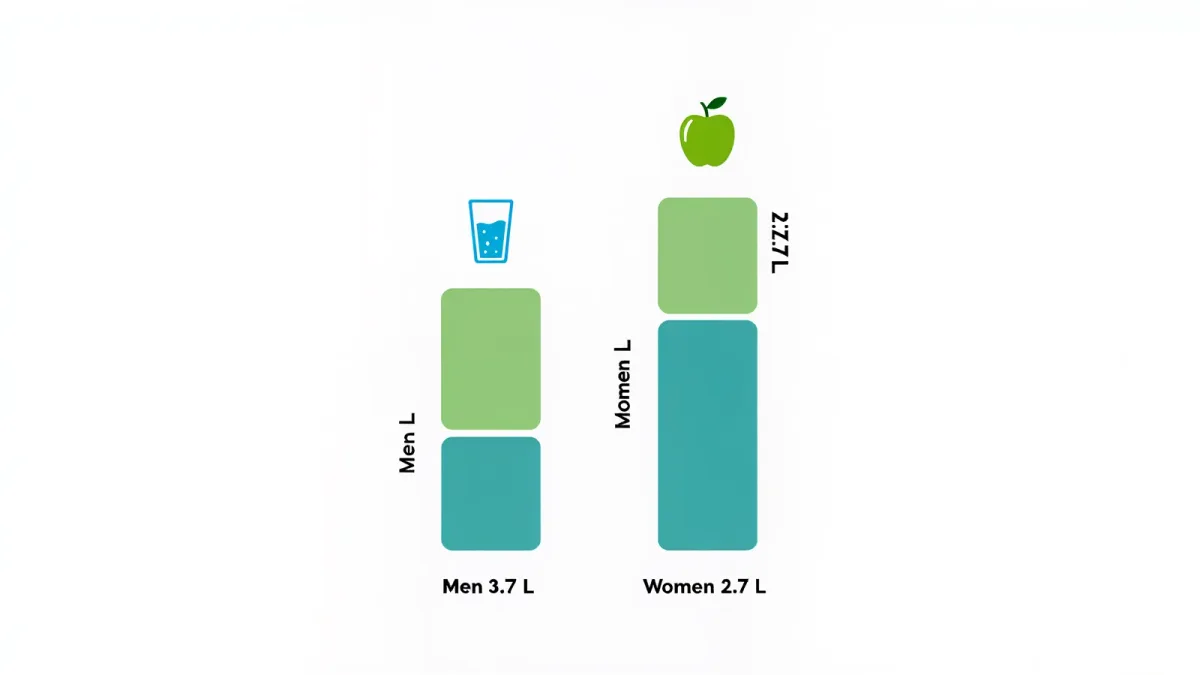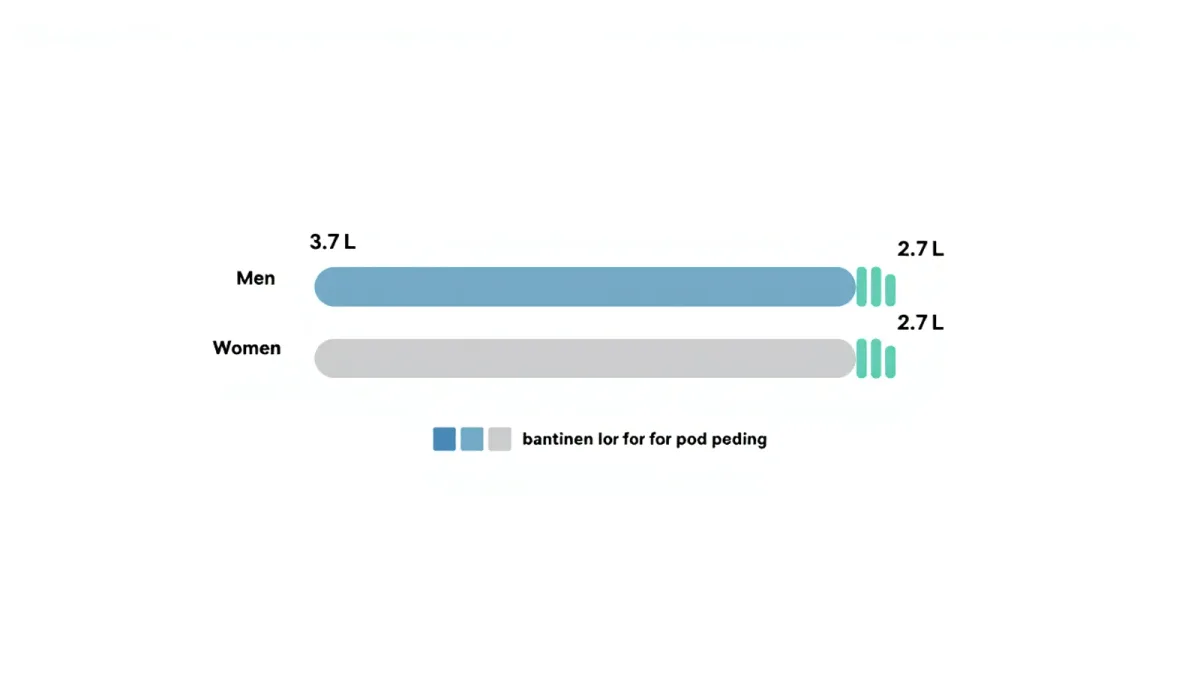
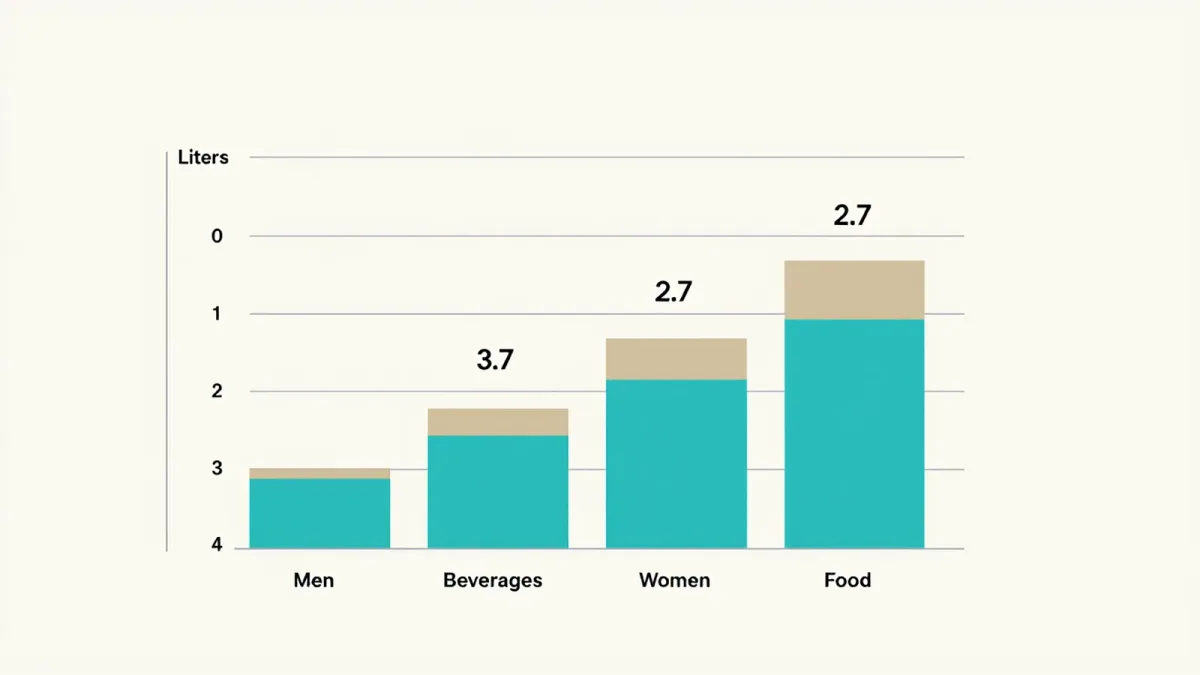
The official figures are 3.7 liters of total water per day for adult men and 2.7 liters for adult women, set as Adequate Intakes by the National Academies in its 2004 dietary reference intakes — and total water means everything: drinking water, other beverages, and the moisture in food, with food and drink each supplying roughly a fifth and four-fifths respectively under typical American diets. The eight-glasses-a-day rule appears nowhere in the federal guidance.
The intake figures here are attributed reference standards for healthy, temperate-climate populations; people with kidney disease, heart failure, or on fluid restrictions, and anyone working in extreme heat, need individual targets from their own clinician or an occupational health provider.
Where did the eight-glasses idea come from?
No one has found a scientific source. Dartmouth physician Heinz Valtin reviewed the question in a 2002 paper in the American Journal of Physiology — Regulatory, Integrative and Comparative Physiology and could locate no study supporting 8 eight-ounce glasses daily for healthy adults; he traced the number plausibly to a 1945 Food and Nutrition Board recommendation that carried the sentence immediately after it — much of the requirement is contained in prepared food — which later retellings dropped. Valtin concluded that for healthy adults in temperate climates, thirst and ordinary beverages suffice, while flagging exceptions: athletes, people in hot conditions, and certain diseases.
What does the Adequate Intake actually measure?
The National Academies' 2004 panel set Adequate Intakes from survey data on the total water consumption of apparently healthy populations, on the logic that intake above this level reflects meeting needs in ordinary conditions. The panel set 3.7 liters total for men and 2.7 liters for women, with about 3.0 and 2.2 liters as beverages respectively, and added allowances rising in pregnancy and lactation. Two features of the standard get lost in retelling: it covers total water from all sources, and it is set for sedentary people in temperate climates — heat and physical work raise needs by liters, not ounces, per the same report.
Water figures by authority and condition
| Issuer | Figure | Population and conditions |
|---|---|---|
| National Academies, 2004 | 3.7 L total water/day, men | Healthy adults, temperate climate |
| National Academies, 2004 | 2.7 L total water/day, women | Healthy adults, temperate climate |
| National Academies, 2004 | About 3.8 L/day total | Pregnancy; 3.8 L in lactation |
| National Academies, 2004 | Adds of 0.6-1 L/hour during exertion | Hot conditions and heavy work, per panel discussion |
The number the guidance actually gives is bigger than eight glasses — and smaller at the same time, because most of it arrives on a fork, not in a bottle.
Do other drinks count?
Yes, in the reference standard's accounting. The National Academies panel treated all beverages — including milk, juice, coffee, and tea — as contributing to total water intake, noting that the caffeine in ordinary doses has a modest diuretic effect that does not fully offset the fluid. Food contributes roughly 19 to 20 percent of total intake in American survey data the panel cited, with fruit, vegetables, soups, and cooked grains carrying most of it. The pop-hydration framing that only plain water counts is a marketing position, not the reference standard.
Can you drink too much?
Yes, and it is the one failure mode with a documented emergency literature. Exercise-associated hyponatremia — dilution of blood sodium from drinking beyond sweat losses during long exertion — caused documented deaths in endurance events, and the 2015 consensus statement from expert panels, including the Wilderness Medical Society, advises drinking to thirst during exercise rather than on a fixed aggressive schedule. The National Academies panel declined to set a Tolerable Upper Intake for water in healthy adults but noted that kidneys handle roughly 0.7 to 1.0 liters per hour at maximum; sustained intake above that is where the risk concentrates. People with heart failure or kidney disease are on clinical fluid restrictions precisely because their tolerance is lower.
Does mild dehydration hurt cognition and mood?
Modest evidence supports an effect at levels of dehydration people actually notice. Studies in adults have found performance on attention and memory tasks and self-rated mood deteriorating at dehydration of roughly 1 to 2 percent of body mass, per research summarized in the National Academies' report and in subsequent reviews — a degree of deficit that thirst usually announces first. The leap from that finding to a benefit from forced extra drinking in already-hydrated people is not supported: trials adding fluids to well-hydrated subjects have not shown performance gains, which is where the eight-glasses promise fails.
What does the newest research add?
A large 2022 analysis of US survey data using serum sodium as a hydration marker, published in eBioMedicine by National Institutes of Health researchers, associated poorer hydration with elevated risks of premature mortality and chronic disease — observational, using a proxy marker, and preliminary in any causal reading; the authors themselves frame it as hypothesis-generating. Water turnover research using isotope-tracking methods has documented wide individual variation in requirements that a single population figure cannot capture. Neither line of work has produced a replacement for the 2004 reference values, and none supports a universal fixed target.
When to talk to a clinician
Fluid decisions are clinical ones for anyone with kidney disease, heart failure, cirrhosis, or a sodium disorder, and for people on diuretics — each condition changes both the floor and the ceiling. Outdoor and industrial workers in heat, and endurance athletes, need plans built on sweat rates and access, which occupational health providers and sports medicine clinicians supply. For healthy, sedentary readers in temperate climates, the reference figures and the 2002 review agree on the working rule the evidence supports: drink when thirsty, count all beverages and food, and recognize that urine color — pale yellow, not clear — is the cheapest hydration check anyone has validated.