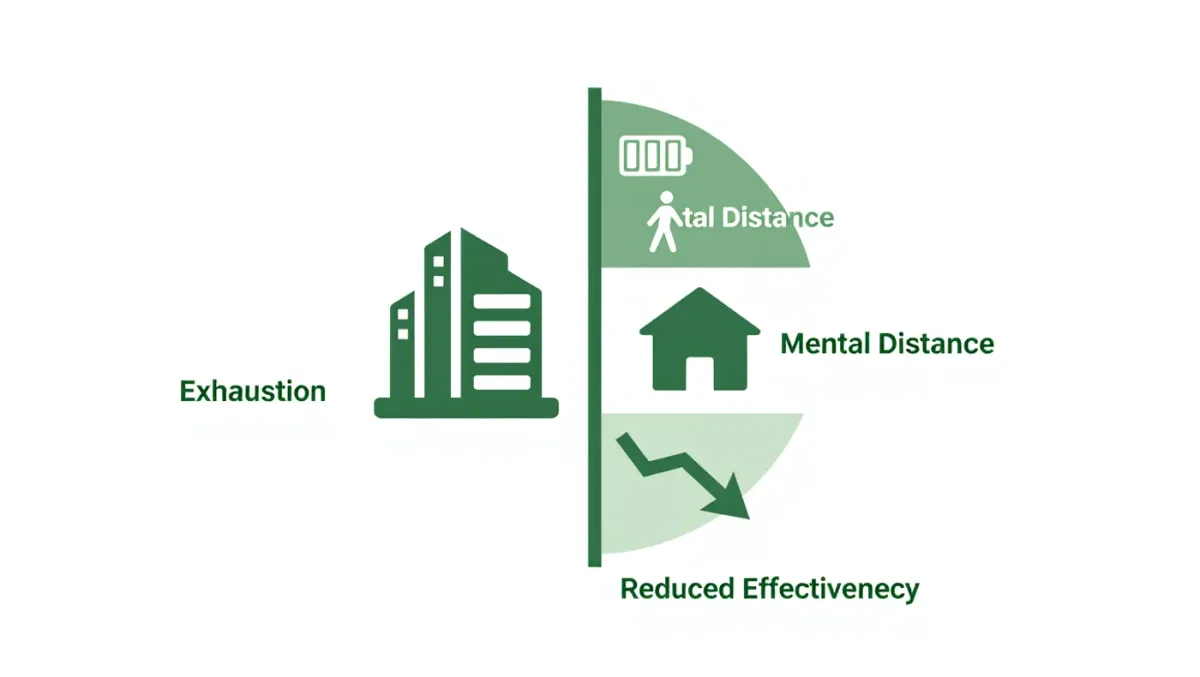
Burnout and depression are separated in research chiefly by domain and diagnostic standing: the World Health Organization's ICD-11, effective January 2022, defines burnout as an occupational phenomenon — exhaustion, mental distance or cynicism, reduced professional efficacy — arising from unmanaged chronic workplace stress, and explicitly not a medical condition, while depression is a mood disorder affecting all life domains. Studies testing whether instruments can tell the two apart report substantial overlap: Renzo Bianchi and colleagues' 2015 review in Clinical Psychology Science and Practice concluded that measures of the two conditions correlate so strongly that a large share of workers scoring high on burnout also screen positive for depression.
This site publishes information, not medical advice. Neither burnout inventories nor anything here diagnoses anything — persistent low mood, sleep disturbance, or hopelessness warrant evaluation by a clinician or mental-health professional.
What exactly does the ICD-11 definition say?
The 2019 ICD-11 classification lists three dimensions: feelings of energy depletion or exhaustion; increased mental distance from one's job, or negativism or cynicism related to it; and reduced professional efficacy. The WHO located burnout in the chapter of factors affecting health status rather than among diseases, framing it as a workplace phenomenon — a placement researchers read as a deliberate boundary claim: by definition, something occurring outside work is not burnout under this framework. The definition descends from Christina Maslach and Susan Jackson's 1981 construct, operationalized in the Maslach Burnout Inventory, which remains the most widely used occupational measure in workforce research.
Where do the two conditions overlap?
The empirical overlap is the field's central method problem. Bianchi and colleagues' review and later papers argued that exhaustion — burnout's core dimension — is also a depression symptom, and that cynicism can function as a depression-typical negative outlook confined to work. Their 2015 conclusion, echoed in a 2021 review in Frontiers in Psychology, was that burnout and depression are distinguishable in principle but frequently co-occur, with some researchers — Bianchi among them — arguing burnout sometimes constitutes depressive phenomenology in an occupational context. Other occupational-health researchers defend burnout's distinctness, pointing to studies where burnout predicts outcomes depression does not, and vice versa. The dispute is live in the literature, not settled.
Markers studies use to separate them
- Domain specificity: symptoms that remit away from work point toward burnout; symptoms across family, social, and leisure domains point toward depression.
- Anhedonia and worthlessness: loss of pleasure and self-reproach are depression-typical per DSM-5 criteria; the ICD-11's burnout dimensions do not include them.
- Sleep and appetite: marked sleep and appetite disturbance receive no mention in the burnout construct and are depression criteria.
- Response to work removal: vacation studies showing symptom relief during time off support an occupational driver, though they do not exclude depression.
Do the screening tools perform differently?
Yes, and validation studies quantify it. The Maslach Burnout Inventory was designed for occupational research, not diagnosis, and its own authors say so; it produces dimension scores rather than a case count. Depression screens such as the PHQ-9 were validated for mood disorders in clinical populations. Studies applying both to the same workforce samples — including work among physicians reviewed in JAMA internal-medicine summaries of clinician mental health — find meaningful fractions of workers classified burned out but not depressed, depressed but not burned out, and both. A 2021 Swedish study in BMC Psychiatry following workers longitudinally reported exhaustion disorder and major depression showed distinct long-term trajectories in some patients and convergent ones in others — preliminary evidence that the constructs diverge over time for at least part of the population.
Why does the distinction matter for workers?
Practically, because the remedies differ. Burnout framed as occupational directs attention to workload, schedule control, and staffing — the structural drivers research by Maslach and Michael Leiter has linked to the construct since the 1990s — and to employer-side interventions. Depression is a treatable medical condition with psychotherapy and pharmacotherapy evidence behind it. Misclassifying one as the other sends a worker to a schedule committee for a mood disorder, or to a prescriber for a staffing problem. Health-care workforces carry both risks: the site's earlier coverage of burnout research among clinicians describes a field built almost entirely on occupational instruments.
The ICD-11 draws the boundary at the workplace; the correlation matrices blur it. Researchers argue about which fact defines the construct — workers deserve instruments honest about both.
When should someone seek evaluation?
The published guidance converges: symptoms persisting weeks, spreading beyond work into sleep, appetite, relationships, or thoughts of self-harm are depression-screening territory and warrant a clinician promptly. Exhaustion and cynicism that track the job, improve with distance from it, and respond to workload changes fit the burnout construct — and even then, concurrent depression is common enough that researchers recommend screening for both rather than choosing one label. Only a qualified clinician can make either determination; no occupational survey substitutes for one.