Adults aged 18 to 60 need at least seven hours of sleep per night, according to guidance the CDC bases on a 2015 joint consensus statement from the American Academy of Sleep Medicine and the Sleep Research Society, published in the journal Sleep. Adults 61 to 64 show seven to nine hours in the same consensus, and adults 65 and older seven to eight. Roughly one in three American adults reports getting less than the recommended minimum, per CDC Behavioral Risk Factor Surveillance System data.
Where does the seven-hour figure come from?
The consensus panel, led by Nathaniel Watson and published in the June 2015 issue of Sleep, reviewed evidence linking sleep duration to health outcomes — cardiovascular disease, obesity, diabetes, impaired immunity, and motor-vehicle crashes — and concluded that seven or more hours per night on a regular basis supports health in adults. The panel deliberately set a floor, not an optimum: some adults function best at eight or nine hours. The CDC adopted the recommendation in its sleep-hygiene materials and tracks adherence through the annual BRFSS survey, which has found the short-sleep share hovering near one-third of adults since 2013.
What are the recommendations by age?
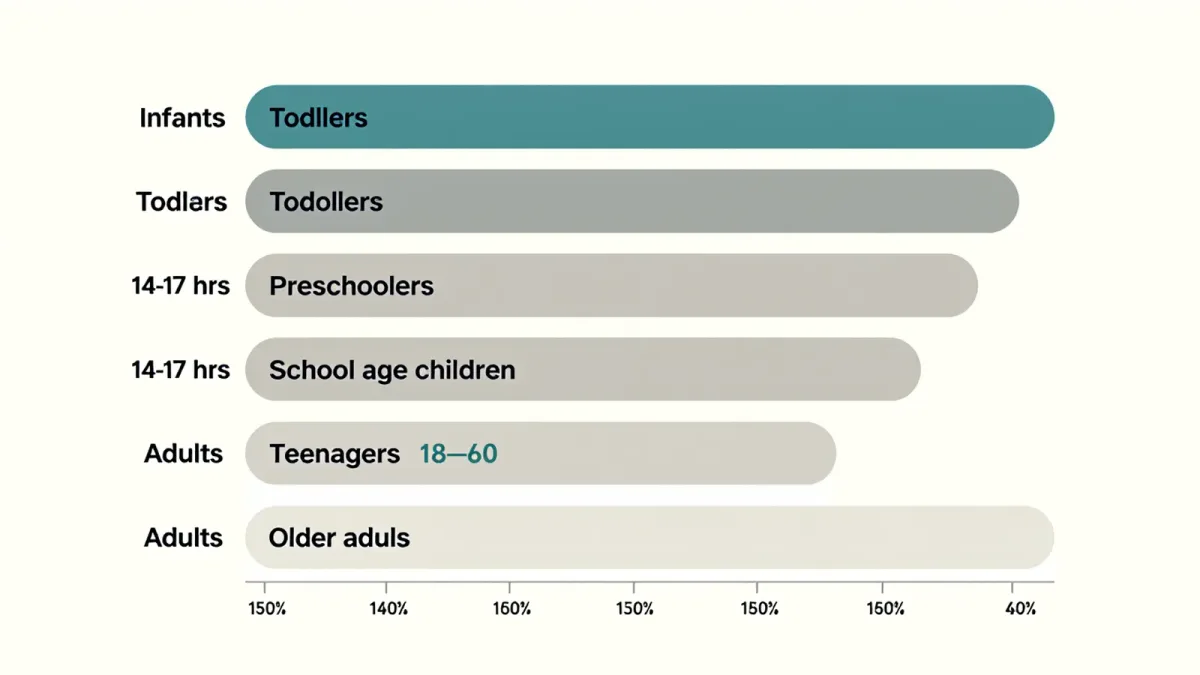
| Age group | Recommended hours per 24 hours | Source |
|---|---|---|
| Infants 4–12 months | 12–16 including naps | AASM consensus, 2016 |
| Children 1–2 years | 11–14 including naps | AASM consensus, 2016 |
| Children 3–5 years | 10–13 including naps | AASM consensus, 2016 |
| Children 6–12 years | 9–12 | AASM consensus, 2016 |
| Teens 13–18 years | 8–10 | AASM consensus, 2016 |
| Adults 18–60 | 7 or more | AASM/SRS consensus, 2015 |
| Adults 61–64 | 7–9 | AASM/SRS consensus, 2015 |
| Adults 65+ | 7–8 | National Sleep Foundation, 2015 |
The pediatric rows come from a parallel American Academy of Sleep Medicine consensus published in 2016, chaired by Lee Brooks and endorsed by the American Academy of Pediatrics. The 65-plus row draws on the National Sleep Foundation's 2015 international panel, whose range for older adults overlaps the AASM figures.
Is more than nine hours a problem?
The consensus addressed a floor. Studies cited in the panel's review found associations between very long sleep — habitually above nine to ten hours — and worse health outcomes, but the direction of causation is unresolved: illness itself can extend sleep, so long sleep may be a marker rather than a cause, a limitation the panel acknowledged. The guidance is not that nine hours harms a healthy adult; it is that seven hours is the minimum with consistent evidence behind it.
Does split sleep count?
The consensus measured total sleep per 24 hours for the general adult population and did not endorse split schedules as equivalent. For shift workers, bi-phasic sleep — a main block plus a nap — is common and partially compensates, but published shift-work research, covered in NIOSH materials, finds daytime sleep runs one to four hours shorter than nighttime sleep even when time in bed is equal, because circadian timing fragments sleep architecture. A worker sleeping six hours at night and six hours in daylight is not getting twelve hours of equivalent sleep.
What happens below the floor?
The 2015 review compiled decades of epidemiology and laboratory work: short habitual sleep is associated with elevated rates of obesity, type 2 diabetes, hypertension, and depression, and laboratory restriction to under six hours degrades reaction time and attention within days. The CDC separately warns that staying awake for 17 to 19 hours produces performance impairment comparable to a blood alcohol concentration at or near the legal driving limit, per laboratory studies the agency cites in its drowsy-driving materials.
How should a worker read the number?
Seven hours is a population floor with named authors and a date — 2015 — not a personal prescription. Adults who regularly need nine hours and wake unrefreshed at seven are describing a normal range of individual variation the consensus did not adjudicate. Chronic insomnia, loud snoring with gasping, or falling asleep during the day are screening signals for sleep disorders, and a clinician can evaluate for apnea or insomnia rather than treating tiredness as a scheduling flaw.
Does quality matter as much as quantity?
The consensus measured duration, but the AASM's own patient materials add a quality criterion: sleep should be restorative, unfragmented, and timed to the person's circadian rhythm. Seven hours of broken sleep with repeated awakenings does not deliver what seven consolidated hours do, per sleep-architecture research the panel drew on. Conditions that fragment sleep — apnea, restless legs, alcohol before bed — can leave an adult meeting the numeric target and still impaired, which is why clinicians treat symptoms as the tiebreaker over the clock number.
For working adults the practical reading is straightforward: aim at the floor, adjust for personal recovery, and treat chronic unrefreshing sleep as a symptom to evaluate. The numbers in the table carry named authors and publication years precisely so readers can check them — the 2015 consensus, the 2016 pediatric update, and the CDC survey series that tracks how far most adults still fall short of both.