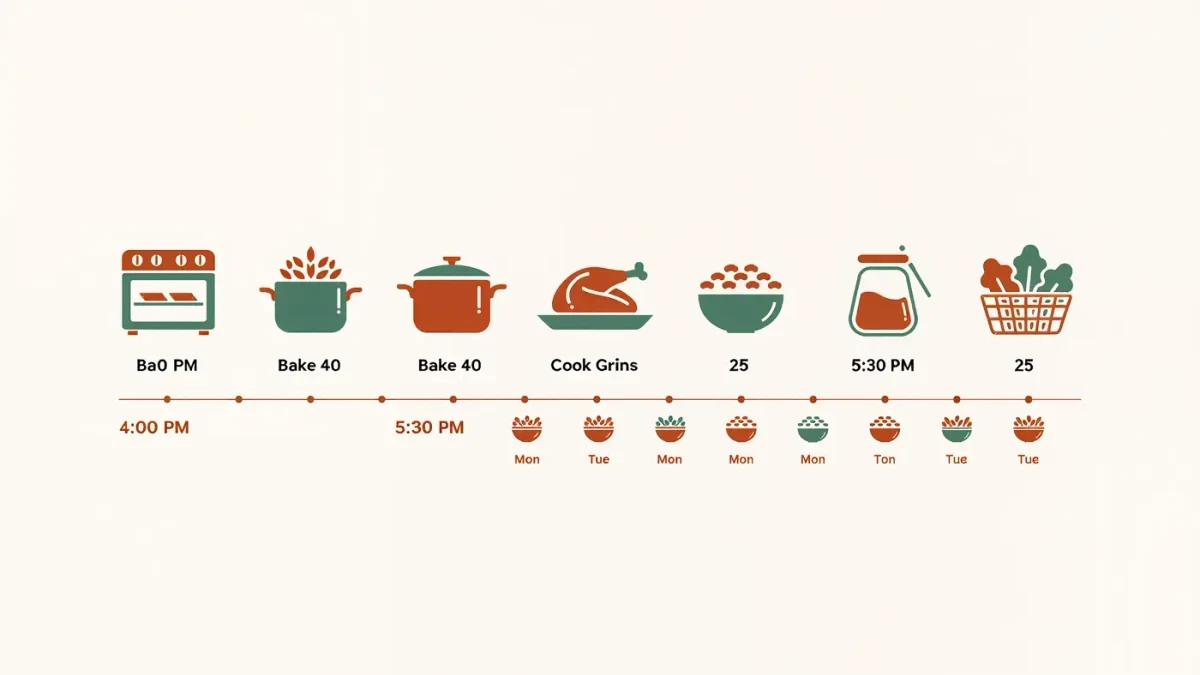

Meal prep for beginners works best as a small Sunday system, not a chef project. Two meals and one shopping list carry most weeks. The safety rails are set by federal guidance: leftovers keep for 3 to 4 days in the refrigerator or 3 to 4 months in the freezer, per the US Department of Agriculture's food safety agency.
The plan below stays forgiving by design. It leans on storage rules from the USDA and on habits that survive a busy week. No gourmet skills are required, and a missed Sunday is not a failure.
What does a first meal prep look like?
The first run fits in one morning. The steps stack in this order:
- Pick two meals that share ingredients, such as a grain bowl and a soup.
- Write the shopping list with amounts before entering the store.
- Cook the shared bases in one block, then cool them quickly.
- Portion into containers within the first two hours after cooking.
- Label and date each container.
- Freeze the portions meant for late in the week.
The order matters more than the recipes. Shared ingredients mean fewer decisions in the aisle and less waste in the fridge at week's end.
Labels and dates are not fussiness. The habit sits inside the standard definition of meal prep: portions packaged in advance, sized the same way and marked so the week stays organized, per the Wikipedia overview of the practice.
How does the food stay safe all week?
Two federal rules carry the load. Cooked food goes into the refrigerator within 2 hours, because bacteria grow fast between 40 and 140 degrees Fahrenheit. And reheated food reaches 165 degrees Fahrenheit on a food thermometer, with soups and sauces brought to a full boil.
The 3-to-4-day limit is where the freezer earns its keep. Portions for day 4 and later should start frozen, not refrigerated. Thawing happens in the refrigerator, in cold water, or in the microwave, per the same guidance. We covered a connected angle in How much water do you actually need, per the National Academies.
Trouble has clear markers. Food left out for more than 2 hours gets thrown out, the USDA states, and reheating does not fix that. Anyone who feels sick after eating week-old food should watch the symptoms closely and see a clinician if they turn severe. For related coverage, see What sell-by and use-by dates on food actually mean — and what they do not.
Why portion and label everything?
Standard portions do two jobs. They keep serving sizes steady from Monday to Friday, and they turn each container into a fixed unit that swaps easily between days. The daily decision also disappears, which is the point of the whole system.
The drawbacks deserve naming. A rigid plan can harden into a rut, and repeated microwaving wears thin plastic containers down, per the same overview. The USDA's reheating guidance already assumes a microwave-safe glass or ceramic dish, and one flexible meal slot absorbs the week's surprises.
Does meal prep actually save money?
The case is real but uneven. Restaurant food carries an average markup around 300 percent, per the overview, so replacing a few takeout lunches moves actual money. One federal figure often quoted in this debate, a 32.6 percent drop in spending on food away from home from 2019 to 2020, came from the Bureau of Labor Statistics and reflects pandemic closures as much as home cooking. Savings vary by city, by store and by how much someone already cooks.
Conclusion: The bottom line
A beginner meal prep is two meals, one shopping trip, and a labeling habit, run inside the federal rails. Cooked food chills within 2 hours, refrigerated portions get eaten within 3 to 4 days, and the rest waits in the freezer. Reheated food reaches 165 degrees Fahrenheit on a thermometer. The next step is small: this Sunday, pick two meals that share a base, shop once, and let the frozen half cover the end of the week.