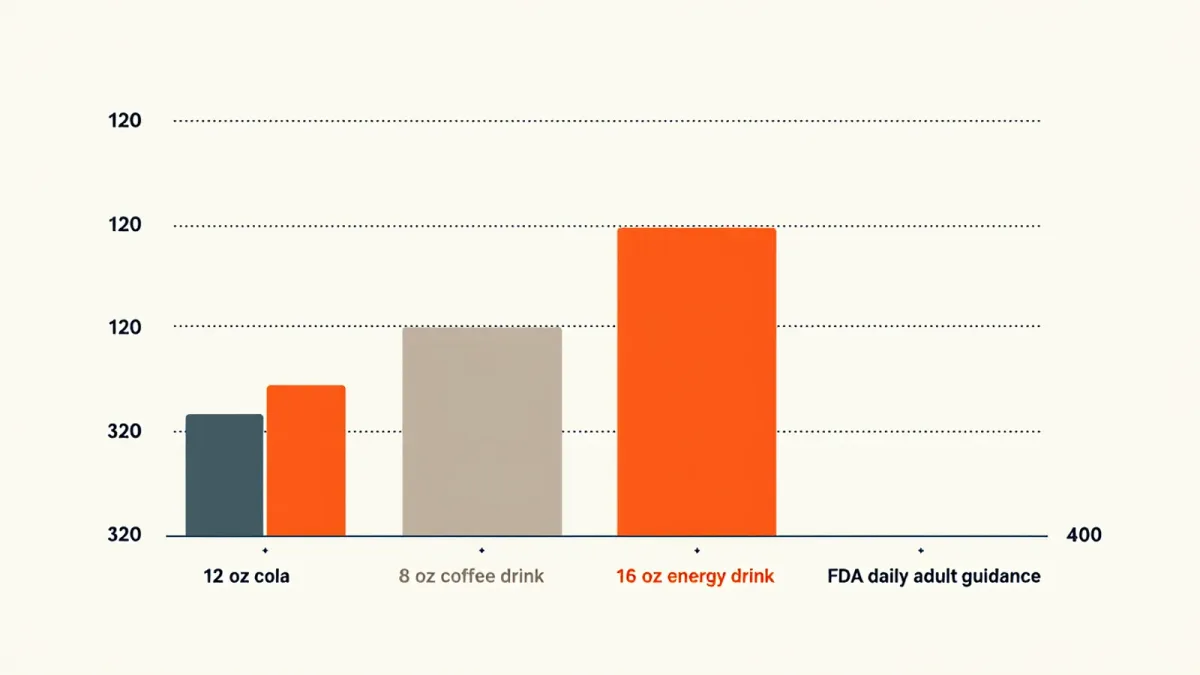
The regulatory picture is asymmetric. Caffeine added to sodas is capped at 0.02 percent by weight — about 71 milligrams per 12 ounces — under a 1980 FDA rule that still stands. Energy drinks, marketed as dietary supplements or conventional foods depending on the producer, carry no FDA caffeine limit at all: cans in the US market hold roughly 80 to 300 milligrams, and the operative federal number is only the agency's general guidance that healthy adults cap total caffeine at 400 milligrams a day, per FDA statements.
The figures here are attributed regulatory and survey facts; anyone with heart arrhythmia, anxiety disorders, hypertension, or pregnancy is outside the 400-milligram healthy-adult framing entirely and should set caffeine intake with their own clinician.
Why does the soda cap not reach energy drinks?
The 0.02 percent cap descends from the FDA's 1980 proposal to classify caffeine as a food additive limit for cola-type beverages, finalized at that level for sodas; a beverage calling itself an energy drink can instead enter the market as a conventional beverage outside the cola rule or as a dietary supplement, where caffeine is treated as an ingredient rather than a capped additive, per FDA regulatory statements and industry labeling practice. Supplement labeling requires listing caffeine in the ingredient declaration but — unlike the EU regime, where the European Food Safety Authority's 2015 assessment led to mandatory high-caffeine warnings — no US rule forces a conspicuous total-milligram statement on the front of the can. The FDA's 2013 incident reporting on caffeine exposure, and its subsequent statements, have repeatedly flagged the labeling gap without a final rule closing it.
How much caffeine is actually in the cans?
Survey and manufacturer labeling data place most 8- to 16-ounce energy drinks between 80 and 300 milligrams: an 8-ounce classic energy shot runs near 80, a 16-ounce flagship can near 150 to 160, and concentrated shots reach 200 or more in under 2 ounces, per analyses published by NIH-affiliated researchers and consumer testing labs. For comparison, the FDA's caffeine reference sheet lists an 8-ounce brewed coffee near 80 to 100 milligrams and a 12-ounce soda under the cap near 30 to 40. Two structural features concentrate the risk: cans are larger than a coffee serving — 16 and 24 ounces are standard — and consumption is faster and often combined with alcohol or exercise, both patterns the FDA has cautioned against.
Regulatory figures at a glance
| Authority and scope | Figure | Applies to |
|---|---|---|
| FDA soda cap, 21 CFR | 0.02% caffeine — about 71 mg per 12 oz | Cola-type sodas |
| FDA guidance | 400 mg/day total caffeine | Healthy adults |
| FDA and AAP guidance | No established safe level for children; AAP advises against energy drinks | Adolescents and children |
| EFSA, 2015 (EU) | 400 mg/day adults; 3 mg/kg single doses; warning labels mandated in EU law | EU market |
| US market products | About 80-300 mg per container | Energy drinks, no product cap |
The same agency caps a cola at 71 milligrams and lets a supplement-basis can carry 300 — the difference is a marketing category, not a safety finding.
What do the health agencies say about children and teens?
The American Academy of Pediatrics' position, stated in its clinical reports and reaffirmed in policy statements, is that children and adolescents should not consume energy drinks at all, and that stimulant-containing drinks have no place in pediatric hydration or sports. The FDA's guidance sets no safe caffeine level for children — its 400-milligram figure is expressly for healthy adults — and national survey analyses published by CDC researchers have documented energy-drink consumption among US high school students, with mixtures of energy drinks and alcohol among the flagged behaviors. Emergency department visits involving energy drinks rose sharply through the 2010s per analyses of the National Electronic Injury Surveillance System data published by federal researchers, with the caveat that such visits document involvement, not causation.
What do the health-effect studies actually show?
The documented acute effects — raised blood pressure, prolonged QT interval in some studies, palpitations, and anxiety at high doses — come from small controlled studies and case series, which the American Heart Association's 2019 scientific statement on energy-drink cardiovascular effects characterized as preliminary but consistent, calling for larger trials. A 2019 randomized crossover study published in the Journal of the American Heart Association found measurable QT and blood-pressure changes after 32 ounces of a commercial energy drink in healthy volunteers — 34 participants, hours-long follow-up, preliminary by design. Coffee, at equal caffeine, has not produced the same signal in comparable trials, leaving researchers with an open question about the drinks' other constituents — taurine, guarana, and high sugar loads — that no completed large trial has resolved.
Has any US regulator moved since?
Slowly, and mostly outside the FDA. Several states have restricted energy-drink sales to minors or introduced labeling bills, per state legislative records through the mid-2020s. The FDA's Center for Food Safety and Applied Nutrition has issued consumer advisories — on mixing energy drinks with alcohol, on pure powdered caffeine, which the agency effectively removed from the retail market after overdose deaths — while the product-category rule the 1980 cola cap created remains unmodified. Internationally, the contrast is sharper: EU law since 2021 mandates high-caffeine warning labeling, and several countries restrict sales below certain ages, per European Commission records. Anyone tracking this space for a workplace policy — and shift-work employers are the obvious constituency — is writing rules where the regulator has not.
When to talk to a clinician
Palpitations, chest discomfort, or tremor after energy drinks warrant clinical evaluation rather than dose adjustment; arrhythmia patients, people with uncontrolled hypertension, and pregnant people are all outside the 400-milligram guidance, which assumes a healthy adult. Shift workers treating fatigue with escalating caffeine are also in clinician territory — caffeine displacement of sleep is the documented mechanism, and a sleep-medicine or occupational-health consultation addresses the cause rather than the symptom.