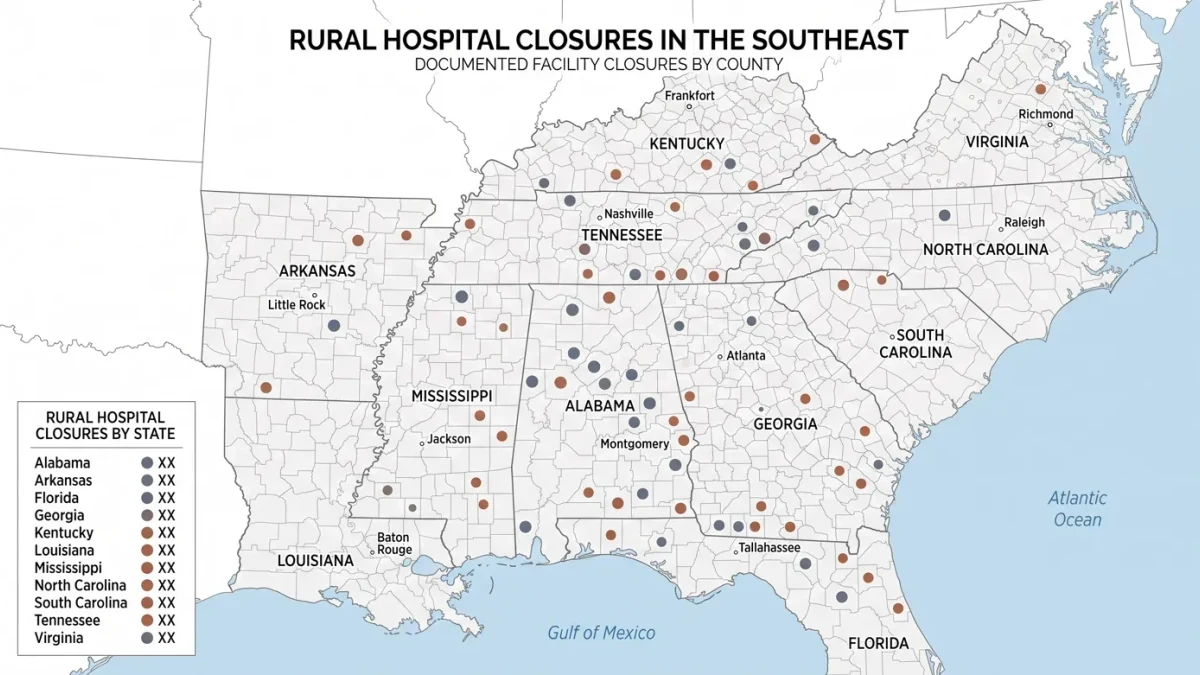

The documented record on rural hospital closures starts with a count. The Sheps Center's national tracker lists 197 closed rural hospitals with closure years from 2005 through 2026. Peer-reviewed work links those closures to shifts in admissions for preventable conditions. What no source documents is a tidy story of one town rebuilding its care.
This account stays inside that record. It does not tell the story of one town's recovery, because the sources below do not document such a narrative from start to finish. What they do show is how often these closures happen and what remained at five New York sites. That is the documented picture, and it is enough to work with.
What counts as a closed rural hospital?
The tracker comes from the Cecil G. Sheps Center for Health Services Research in North Carolina. It follows a strict rule on what counts. A closed hospital, by a definition drawn from the Office of Inspector General, stopped providing general, short-term, acute inpatient care. A merger that keeps inpatient care does not count. Neither does a conversion to a critical access hospital or a rural emergency hospital. A same-year reopening at the same site does not count either. Counted from the published list, the tracker carries 197 facilities with closure years from 2005 to 2026. The stretch from 2013 through 2020 was the busiest, with eight to seventeen closures listed per year.
What happens to admissions after a closure?
A 2023 study in the Journal of Rural Health tracked nine states from 2010 to 2017. Its authors work at the CDC and the Sheps Center. The team compared rural ZIP code areas served by a closed hospital with areas that kept theirs. Admissions for ambulatory care sensitive conditions rose right before a closure. They stayed higher for nearly two years after. Emergency care sensitive admissions dipped before closure day. Length of stay for those admissions fell about a year after closure. The authors' conclusion: closures came with a rise in preventable admissions, so access to primary care matters once the doors close.
What happened at New York's closed rural hospitals?
New York appears five times in the tracker list. Amsterdam Memorial Hospital and Albert Lindley Lee Memorial Hospital carry 2009 closure years. Lake Shore Health Care Center is listed at 2017. Moses-Ludington Hospital and Tri-Town Regional Hospital are listed at 2018. The list also records what remained at each site. Three kept urgent or emergency care. Two kept outpatient, primary care, or rural health clinic services. No New York facility appears in the list's 2019 through 2026 rows. The state's documented closures in this dataset end in 2018. Readers following this should also see Brooklyn's Maimonides moves to join NYC Health + Hospitals in a $2.2 billion New York hospital merger.
Can inpatient care end and doors stay open?
Yes, and the tracker treats that path as separate. Conversions to critical access hospitals or rural emergency hospitals do not count as closures. A critical access hospital holds no more than 25 inpatient beds and keeps average stays under 96 hours, with 24-hour emergency care required. That model dates to the Balanced Budget Act of 1997. A count compiled on Wikipedia's critical access hospital entry put the number of certified hospitals at 1,377 across 45 states as of July 2025. Recent rows in the Sheps list show rural emergency hospital conversions next to full closures. The pattern is a documented middle path. The inpatient unit ends, while emergency or clinic services continue at the same address.
Conclusion: The bottom line
The documented picture has three parts. The Sheps list carries 197 rural hospitals closed from 2005 through 2026. Admissions for preventable conditions rise around closures and stay high for about two years. The five New York sites in the list all kept some form of care after losing inpatient units. A reader in a town facing closure can check the tracker for the services that remain, then confirm the facility's status with the state health department. This connects to our earlier piece, Work fatigue costs employers $218 billion a year, and health care carries outsized risk, federal data show.