
New York's hospital staffing debate returned to Albany on March 10, 2026, when the New York State Nurses Association held its annual Lobby Day, pressing legislators on safe-staffing levels and, per the union's own account, on "enforcement of our state's staffing laws" — while the bill that would mandate fixed nurse-to-patient ratios remained without a committee vote.
HEALTH WORK NY publishes information, not career or medical advice. Union positions below are union positions; legislative status is drawn from the Senate's published bill records and issue pages.
What the union is asking for
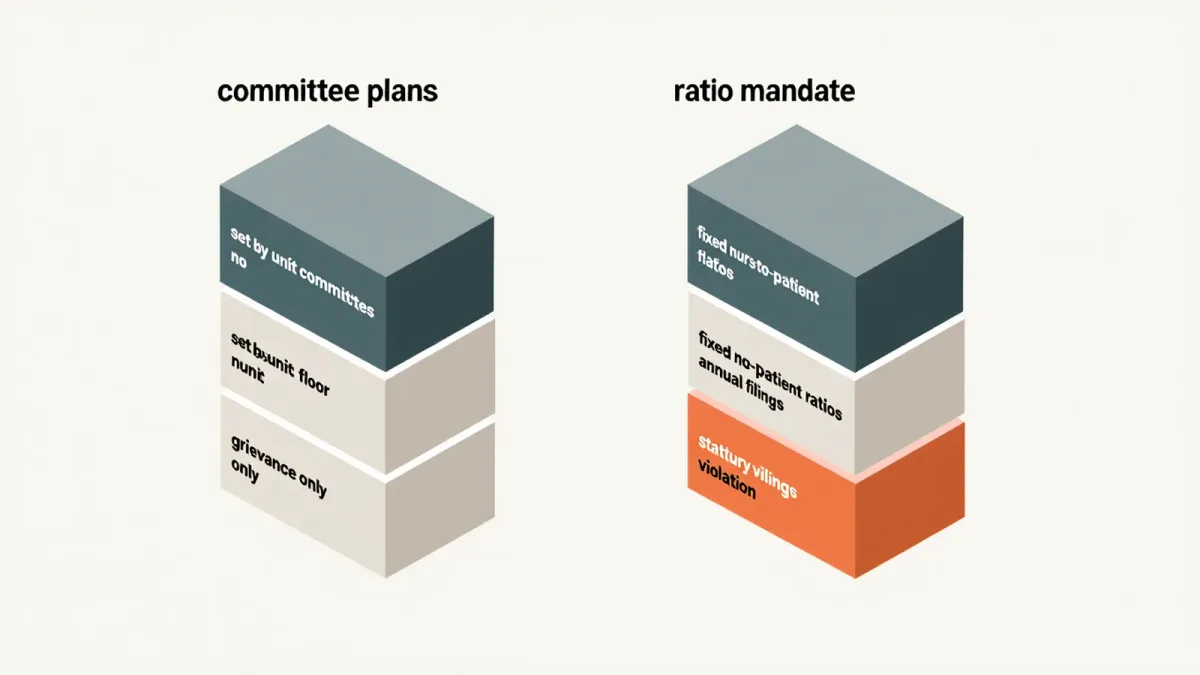
NYSNA's 2026 session agenda, laid out when the session began in January, bundles three priorities: safe-staffing improvements, revenue measures to fund health care, and passage of the New York Health Act. The staffing item is the one with a live legislative vehicle. Senators maintain a Safe Staffing issue page tracking bills to raise staffing levels in hospitals and nursing homes, and the session's ratio bill — S4003 — would require hospitals to file annual staffing plans with specific nurse-to-patient ratios by unit, replacing the committee-negotiated plans the 2021 law relies on.
The distinction matters. New York's current framework, in force since 2021, requires hospitals to run staffing committees that set unit-level plans, but sets no numeric floor and — the union's core complaint — no meaningful penalty when plans are missed. A ratio mandate would convert committee discretion into fixed numbers, with enforcement the open question in every version filed.
What it changes for workers
For nurses and direct-care staff, the difference between the two frameworks is procedural power. Under committee law, a nurse assigned above plan has a documentation problem to escalate; under an enforced ratio statute, the assignment itself would trigger a violation. That is why the union's 2026 messaging emphasizes enforcement language rather than new committee requirements — per NYSNA's session materials, the existing law's weakness is what happens, or does not happen, after a plan is filed.
Hospital employers, represented by their associations, have opposed ratio mandates on the grounds that fixed numbers cannot flex with acuity and that the nursing shortage makes ratios unstaffable — an argument that gained force after the 2026 NewYork-Presbyterian strike settled for contractual staffing language rather than statutory change. Whether the strike's outcome strengthens or weakens the legislative push is the unspoken question in this session's staffing debate.
Where the bills stand
As of the March 10 Lobby Day, the ratio bill had not advanced from committee, and neither chamber had scheduled floor action on staffing mandates. The session runs through June, when budget negotiations will determine whether staffing enforcement attaches to any health-care spending bill. Nurses following the process can track the Senate's Safe Staffing issue page, which lists active legislation; the practical takeaway for workers is that New York's staffing rules in 2026 remain the committee framework, and any change this year will come late in the session or not at all. Nurses evaluating employers this hiring season should therefore treat posted staffing plans as committee products — unit-specific, negotiable, and enforceable only through the mechanisms the 2021 law provides.