
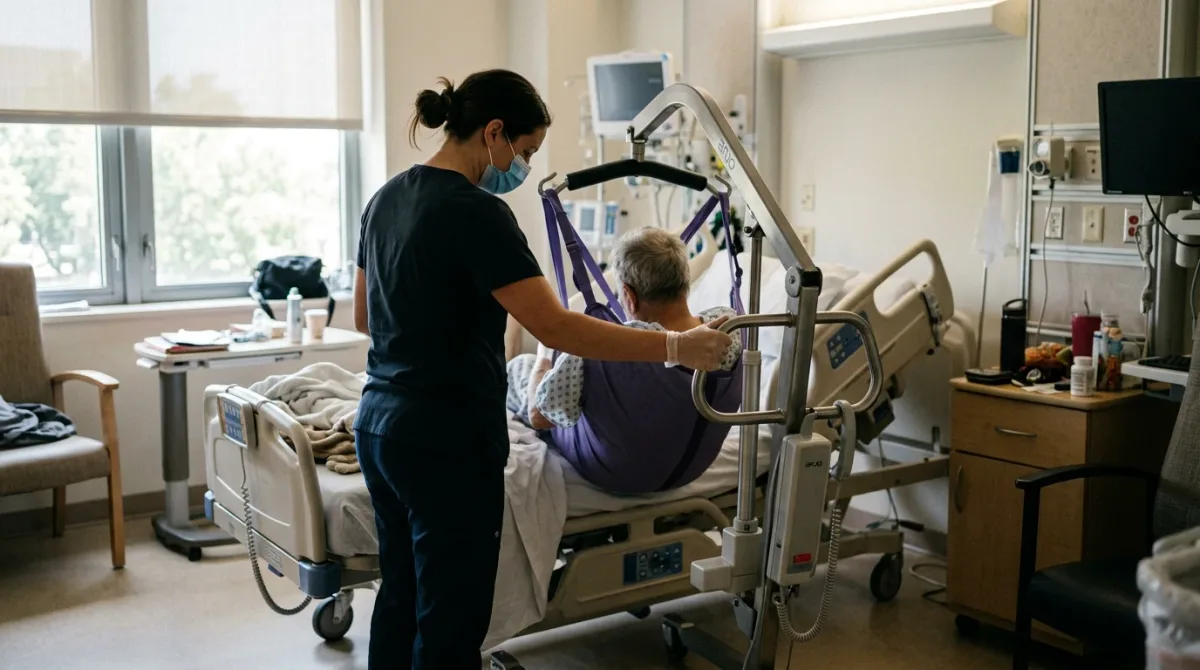
Manual patient lifting and repositioning drive most of the musculoskeletal injuries reported among U.S. health care workers, and nursing assistants absorb the worst of it: an incidence rate of 166.3 lost-workday injuries per 10,000 workers, more than five times the all-industry average of 30.5, according to the Occupational Safety and Health Administration's safe patient handling guidance.
This piece explains what causes those injuries, what federal agencies recommend to prevent them, and what the research says about whether prevention programs work. It is general information, not medical or career advice; workers with pain or a suspected injury should talk to their own clinician or their employer's occupational health service.
How big is the injury problem in health care?
Health care has one of the highest injury burdens of any U.S. industry sector. OSHA's overview of health care hazards cites 806,200 total recordable injury and illness cases across the industry in 2020, a 40 percent jump from the year before, with an incidence rate of 5.5 cases per 100 full-time equivalent workers, up from 3.8 in 2019 — a year that coincided with the early COVID-19 pandemic. Of those cases, 447,890 involved at least one day away from work.
Musculoskeletal disorders are a large share of that toll. OSHA reports that nursing assistants alone logged 15,360 musculoskeletal-disorder cases in 2020, accounting for 52 percent of all days-away-from-work cases in that occupation.
What actually causes these injuries?
The federal National Institute for Occupational Safety and Health (NIOSH), in a research summary on musculoskeletal disorders in the health care industry, attributes the injuries to manual patient handling, excessive pushing and pulling forces, awkward postures during care, and extended shifts. OSHA's safe patient handling guidance is more specific: the highest-risk tasks are transferring patients between surfaces — toilet to chair, chair to bed, bathtub to chair — and repositioning patients in bed, with sprains and strains to the shoulders and lower back the most common result. Both agencies note the problem is intensified by rising average patient weight and an aging population that needs more hands-on assistance with daily activities.
NIOSH's summary adds that no clinical setting is exempt: workers in hospitals, nursing homes, emergency services, operating rooms, orthopaedic units and home health care all face the same occupational risk factors, with orthopaedic nurses flagged as particularly exposed.
What does OSHA recommend to prevent them?
OSHA's core recommendation is to stop relying on manual lifting. Its guidance describes mechanical patient transfer and lifting devices as "key components of an effective program," embedded in a broader safe patient handling program that includes management commitment, worker participation in designing the program, a hazard assessment of specific units and tasks, investment in lift equipment, updated care planning, staff training on the equipment, and ongoing evaluation of whether the program is working. The agency's position is that ending manual lifting — not simply teaching better lifting technique — is what reduces injury risk.
Does the research back up safe patient handling programs?
NIOSH's research summary, published in the journal Orthopaedic Nursing, describes NIOSH-conducted epidemiological studies evaluating safe patient handling programs in real health care settings alongside laboratory studies measuring the biomechanical stress that lift equipment removes from workers' bodies. The agency also developed training materials aimed at nursing schools, to reach workers before injury patterns set in. NIOSH characterizes the resulting evidence as showing that "significant occupational risks for musculoskeletal disorders exist and that effective interventions are available to reduce the risk" — a conclusion attributed to NIOSH's own research program rather than an independent finding.
What does this cost workers and employers?
OSHA's safe patient handling guidance puts the direct and indirect cost of back injuries in health care at an estimated $20 billion a year, and states that roughly 20 percent of nurses leave direct patient care because of work-related injury risk — a workforce-pipeline consequence, not just a safety statistic, in an industry already managing chronic staffing gaps.
When to talk to a clinician
This article describes agency findings and recommendations; it is not a diagnosis or treatment guide. A worker experiencing back, shoulder or joint pain after patient-handling tasks should report the injury through their employer's occupational health or workers' compensation process and see their own clinician or an occupational medicine provider for evaluation — not rely on this article to assess symptoms.
| Metric | Figure | Source | Year |
|---|---|---|---|
| Nursing assistant injury rate (days away from work) | 166.3 per 10,000 workers | OSHA, citing BLS data | 2017 |
| All-industry average injury rate | 30.5 per 10,000 workers | OSHA, citing BLS data | 2017 |
| Total health care injury/illness cases | 806,200 | OSHA | 2020 |
| Health care incidence rate | 5.5 per 100 FTE workers | OSHA | 2020 |
| Estimated annual cost of back injuries in health care | $20 billion | OSHA | not dated in source |
Frequently asked questions
What counts as a musculoskeletal disorder in this context? OSHA and NIOSH use the term for sprains, strains and related injuries to muscles, tendons, ligaments, discs and joints, most often affecting the shoulders and lower back among health care workers handling patients, according to OSHA's safe patient handling guidance.
Does a mechanical lift eliminate the risk entirely? No agency reviewed here claims that. OSHA describes lift equipment as a key component of a broader program that also requires training, care planning and evaluation — not a standalone fix, per its safe patient handling guidance.
Which health care workers are most exposed? Nursing assistants show the highest documented injury rates in OSHA's data, and NIOSH's research summary notes that hospital, nursing home, emergency services, operating room, orthopaedic and home health workers all face the same handling-related risk factors.
For a related workplace perspective, read New York's ICU nurse-staffing rule is four years old. Hospitals still miss it more than half the time, union data show.