
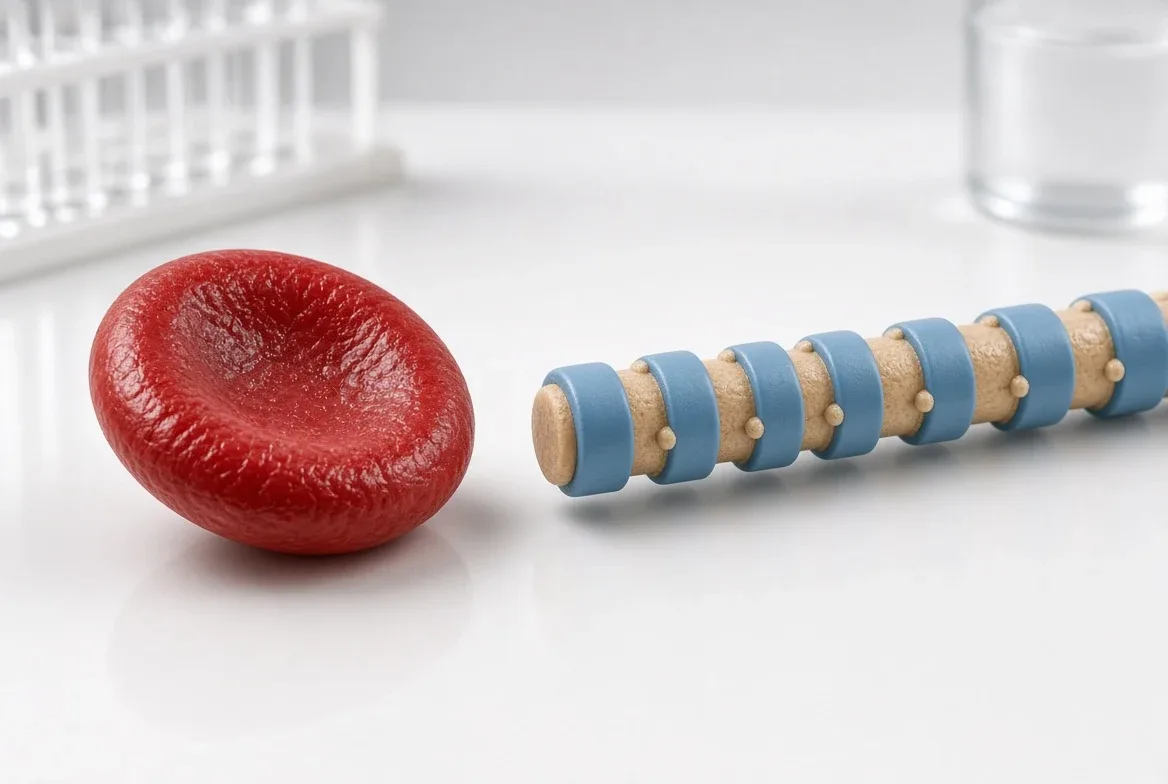
Vitamin B12 is a water-soluble nutrient the body needs for nerve cell function, the formation of red blood cells, and DNA synthesis, and it cannot be made by the body, so it must come from food or supplements, according to the National Institutes of Health's Office of Dietary Supplements (NIH ODS), updated July 2025. Deficiency is most common in older adults, strict vegans, and people with absorption disorders, and it can take years to produce symptoms.
Vitamin B12, also called cobalamin, belongs to a family of chemically related compounds that the body uses as cofactors for two enzymes central to everyday metabolism, per the NIH ODS Health Professional Fact Sheet. One of those enzymes, methionine synthase, converts homocysteine into methionine, a step involved in DNA synthesis and in maintaining the fatty sheath that insulates nerve fibers. The other, L-methylmalonyl-CoA mutase, helps break down certain fats and proteins for energy. Because both processes are ongoing in tissues that divide quickly or transmit electrical signals, adequate vitamin B12 is described by the NIH ODS as necessary for central nervous system development and function and for the healthy formation of red blood cells.
How does the body absorb vitamin B12?
Absorption is a multistep process that starts in the stomach and finishes in the last section of the small intestine, and any disruption along that path can lead to deficiency even when a person eats enough B12, according to a StatPearls clinical reference chapter maintained on the National Library of Medicine's NCBI Bookshelf, last updated September 2024. Dietary B12 first binds to a salivary protein called R-factor; pancreatic enzymes later release it from that protein in the small intestine so it can bind to intrinsic factor, a glycoprotein produced by acid-secreting cells in the stomach lining. That intrinsic factor–B12 complex is what allows absorption to occur in the terminal ileum, the final stretch of the small intestine. A defect at any of these steps — reduced stomach acid, loss of intrinsic factor, or damage to the ileum — can block absorption regardless of dietary intake.
This is why vitamin B12 deficiency is not simply a question of eating too little of the vitamin. In many cases, the underlying cause is a problem absorbing what is otherwise an adequate amount in the diet, which is part of why clinicians evaluate deficiency by looking at a person's digestive history and medication list alongside their diet.
How much vitamin B12 do people need?
Adults need 2.4 micrograms of vitamin B12 a day, with slightly higher amounts recommended during pregnancy and breastfeeding, per the Recommended Dietary Allowances (RDAs) published by the NIH ODS.
| Life stage | Recommended amount (mcg/day) |
|---|---|
| Birth to 6 months* | 0.4 |
| 7–12 months* | 0.5 |
| 1–3 years | 0.9 |
| 4–8 years | 1.2 |
| 9–13 years | 1.8 |
| 14 years and older | 2.4 |
| Pregnancy | 2.6 |
| Breastfeeding | 2.8 |
*Adequate Intake rather than RDA, per NIH ODS. Animal foods are the natural source of vitamin B12: fish, meat, poultry, eggs, and dairy, with clams, beef liver, and oysters among the most concentrated sources. Because plant foods do not naturally contain the vitamin, fortified breakfast cereals and nutritional yeast are the main routes to meeting the recommended amount on a fully plant-based diet, according to the NIH ODS.
What causes vitamin B12 deficiency?
Deficiency has several distinct causes, and the StatPearls chapter groups them into four broad categories: autoimmune disease that blocks intrinsic factor, malabsorption from gastrointestinal surgery or conditions such as Crohn's disease and celiac disease, prolonged dietary insufficiency in people following a strictly plant-based diet, and interference from certain medications or toxin exposure. In pernicious anemia, the autoimmune form, the immune system produces antibodies that stop intrinsic factor from doing its job, which blocks absorption even when intrinsic factor is otherwise present. Long-term use of metformin, a common diabetes medication, and long-term use of proton pump inhibitors, which reduce stomach acid, are both associated with lower B12 absorption over time, according to both the NIH ODS Consumer Fact Sheet, updated December 2023, and the StatPearls chapter. Nitrous oxide exposure is a less common but recognized cause, because it inactivates the vitamin's active form in the body.
Who is most at risk, and how common is deficiency?
Older adults, people with pernicious anemia or inflammatory bowel disease, those who have had weight-loss or stomach surgery, and people who eat little or no animal food are all considered at elevated risk, per the NIH ODS Consumer Fact Sheet. Reduced stomach acid production becomes more common after age 50, which is part of why age itself is listed as a risk factor independent of diet.
On prevalence, the StatPearls chapter cites a 2007–2018 analysis of National Health and Nutrition Examination Survey (NHANES) data finding that roughly 3.6 percent of US adults aged 19 and older had vitamin B12 deficiency, defined as a serum level below 200 picograms per milliliter, while about 12.5 percent had insufficiency, defined as a level below 300 picograms per milliliter. Among adults 60 and older, deficiency by that same NHANES analysis was around 3.7 percent, though the chapter notes that estimates specifically among community-dwelling older adults have ranged much more widely, from roughly 3 percent to 43 percent, depending on which lab threshold a given study used to define deficiency. That range illustrates a genuine point of uncertainty in the evidence: there is no single, universally agreed lab cutoff for diagnosing deficiency, and studies using different thresholds will report very different prevalence figures for the same population.
What symptoms has this been associated with?
Fatigue, weakness, pale skin, loss of appetite, and heart palpitations are among the deficiency symptoms listed by the NIH ODS Consumer Fact Sheet, which also lists numbness or tingling in the hands and feet, balance problems, depression, confusion, and memory difficulty as effects reported with more advanced or prolonged deficiency. The fact sheet notes that symptoms can take years to appear, because the body stores several years' worth of vitamin B12 in the liver. At the more severe end, the StatPearls chapter describes a neurological complication known as subacute combined degeneration of the spinal cord, which can produce loss of position sense, unsteady gait, and peripheral nerve damage, and which the chapter notes can occur even before anemia becomes apparent on standard blood tests. Because B12 deficiency can suppress red blood cell production, it is also a recognized cause of megaloblastic anemia, a form of anemia marked by unusually large, immature red blood cells, per the NIH ODS.
What remains uncertain?
Two areas of the evidence are still unsettled. First, as noted above, researchers have not converged on a single serum B12 threshold for diagnosing deficiency, which is why the StatPearls chapter describes clinicians often confirming a borderline result with a methylmalonic acid test, since MMA tends to rise when B12 is truly deficient at the cellular level even when serum B12 sits in a gray zone between roughly 150 and 400 picograms per milliliter. Second, the NIH ODS Health Professional Fact Sheet notes that high-dose oral B12 supplementation, in the range of 1,000 to 2,000 micrograms daily, appears comparably effective to intramuscular injections for treating diagnosed deficiency, a finding that has shifted some clinical practice toward oral treatment first, though the fact sheet frames this as evidence to weigh with a clinician rather than a universal recommendation, since the right approach depends on the underlying cause of the deficiency. The NIH ODS also states that no tolerable upper intake level has been set for vitamin B12, reflecting its low potential for toxicity, which is distinct from saying high doses are appropriate for everyone.
When should someone see a doctor?
Because deficiency symptoms overlap with many other conditions and can build gradually, the NIH ODS Consumer Fact Sheet advises that anyone experiencing persistent fatigue, numbness or tingling in the hands or feet, balance problems, or unexplained memory or mood changes should discuss the possibility of vitamin B12 deficiency with a healthcare provider, particularly if they are over 50, follow a vegan or strictly plant-based diet, have a digestive condition, have had stomach or intestinal surgery, or take metformin or long-term acid-reducing medication. A blood test can confirm whether B12 levels are low. This article provides general health information rather than medical advice, and it is not a substitute for an evaluation by a qualified clinician; anyone with these symptoms should seek personalized medical guidance rather than self-diagnosing or self-treating.
For a related health news perspective, read The Ultimate Guide to Dental Crown Care and Maintenance.
For more context, read Complete Guide to Building a Sustainable Wellness Routine.
For more context, read How Much Protein Do You Actually Need Each Day?.
For more context, read What to Know About Magnesium and Sleep.