
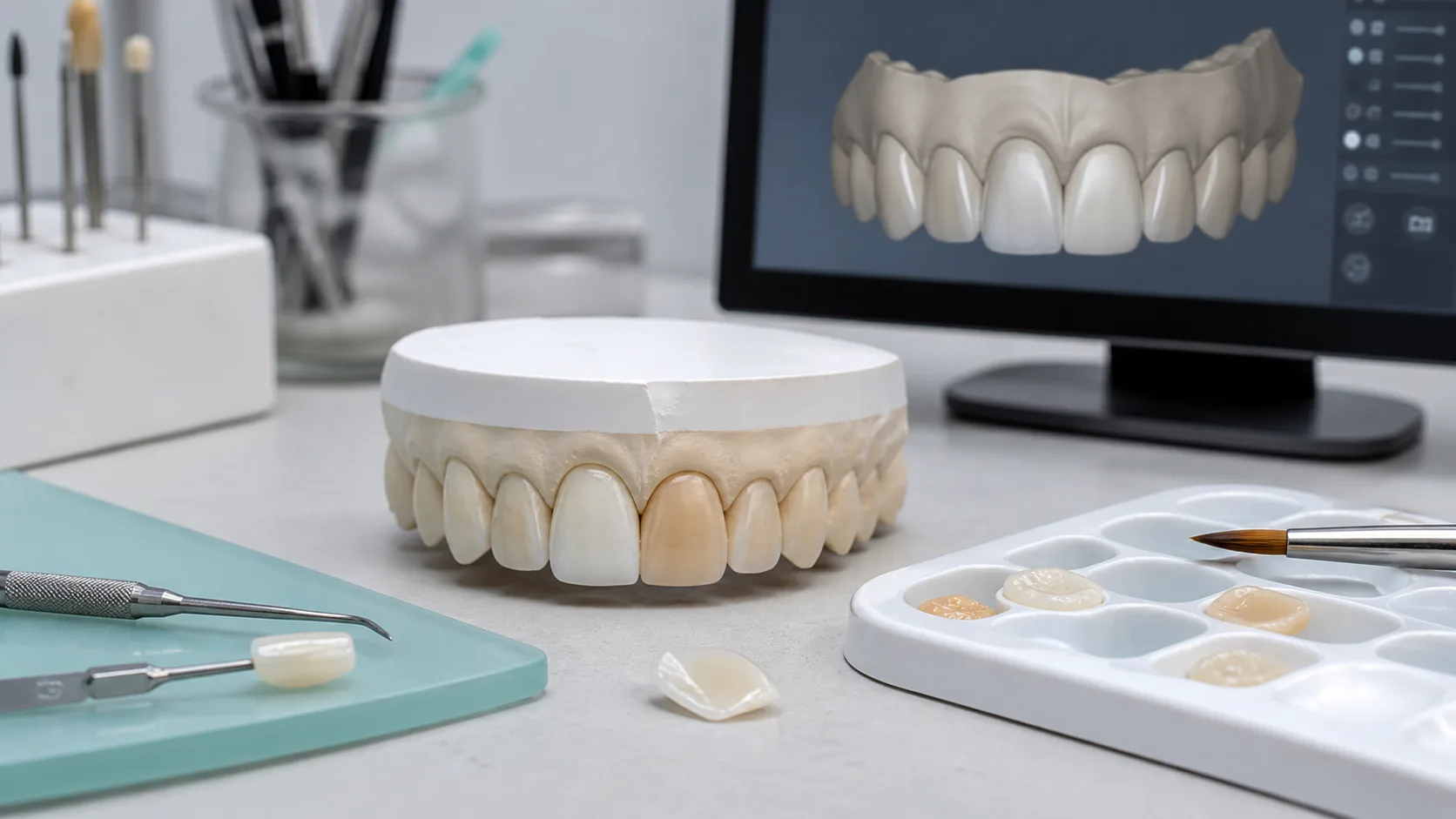
Dental veneers are thin, custom-made coverings bonded to the front of selected teeth. They can change the appearance of color, shape, chips, small gaps, or mild unevenness, but they do not move teeth or treat decay, gum disease, or an unhealthy bite. A licensed dentist should assess oral health, tooth structure, and bite before recommending them.
The two broad material groups are ceramic—often described as porcelain—and composite resin. Their appearance can be natural, but neither is a lifetime or risk-free solution. Benefits must be weighed against enamel removal, sensitivity, fracture or debonding, maintenance, cost, and eventual repair or replacement. This overview is general information, not individual dental advice.
Main types of dental veneers
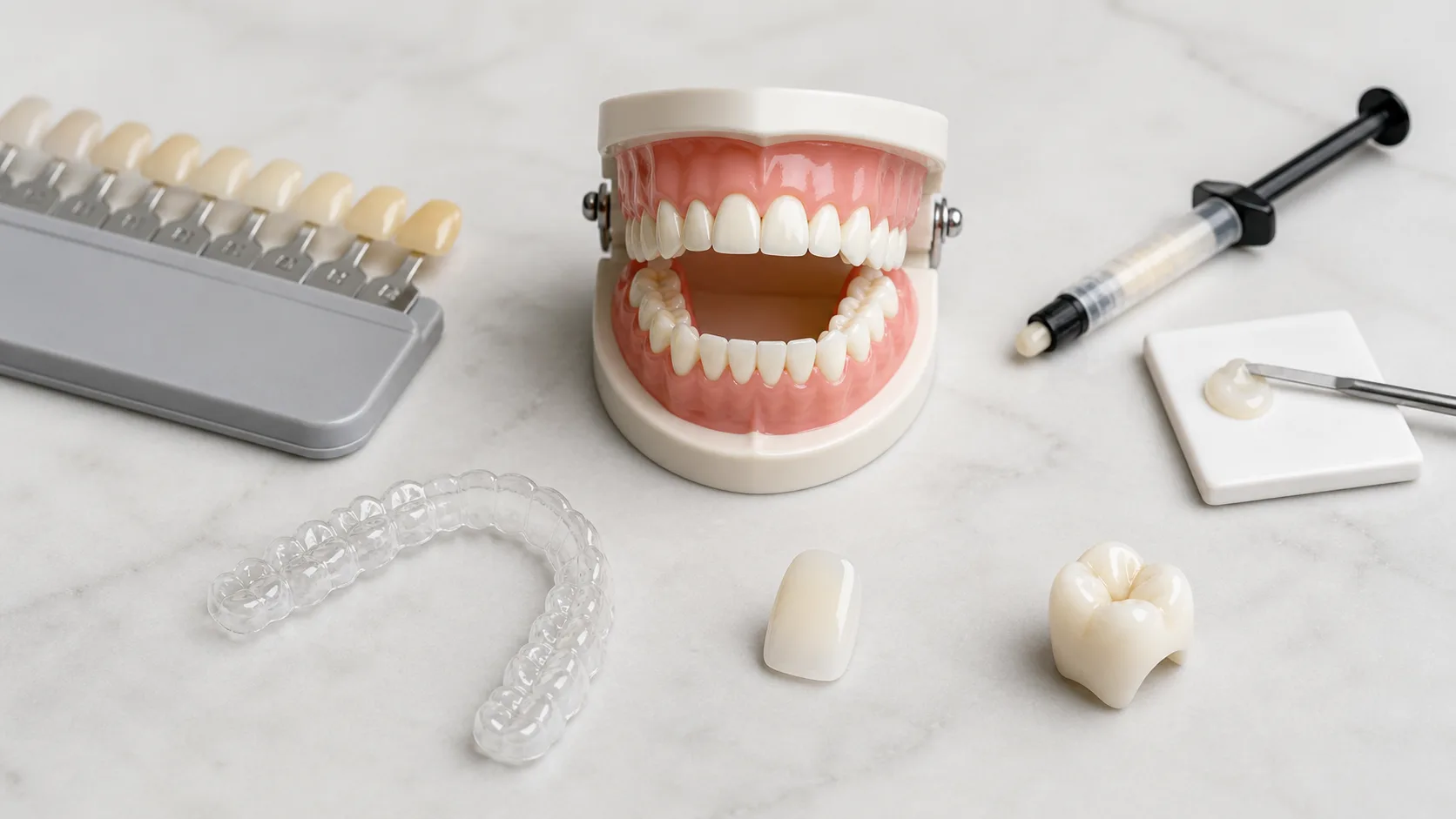
Ceramic veneers are fabricated outside the mouth by a laboratory or compatible digital workflow. Common ceramic families include feldspathic porcelain, leucite-reinforced glass ceramic, and lithium disilicate. They can provide stable color and enamel-like optical properties, but they may chip, crack, or debond. Repair can be difficult, and replacement may require additional tooth treatment.
Composite veneers use tooth-colored resin. Direct composite is placed, sculpted, and polished by a dentist, sometimes in one visit. Indirect composite is fabricated outside the mouth. Composite can often be repaired more readily and may require less enamel removal in selected cases, but it can wear, stain, lose polish, or fracture. It is inaccurate to promise that composite is always reversible.
“No-prep” and “minimal-prep” describe approaches, not separate materials. The American Dental Association’s veneer guidance notes that enamel is usually removed and the process is generally not reversible. Even low-preparation approaches are suitable only when tooth position, contour, color, and bite provide enough space. A branded product name does not create a third evidence-based veneer category.
What veneers can—and cannot—change
Veneers may be considered for stains that do not respond predictably to whitening, small chips, worn edges, shape differences, undersized teeth, or selected spaces. They can mask the appearance of mild rotation or unevenness, but that is not the same as orthodontic movement. Veneers do not correct jaw relationships, severe crowding, or an unstable bite.
The supporting teeth and gums must be healthy enough for elective treatment. Extensive decay, active gum disease, inadequate enamel, major structural damage, deep bite relationships, or heavy grinding can change the recommendation. A dentist may first treat disease, propose orthodontics, select a crown for a weakened tooth, or advise no intervention.
Color planning also has limits. Ceramic generally resists staining better than composite and natural enamel, but margins and neighboring teeth can discolor. Bleaching does not change a veneer’s underlying shade. Anyone considering whitening should discuss its timing before definitive shade selection.
Benefits balanced with risks and limitations
Potential benefits include changing several visible features at once, matching neighboring teeth, and conserving more tooth structure than a full crown in an appropriate case. Direct composite may allow conservative repair of a small defect. Ceramic may offer strong optical and color stability. These are possibilities, not guarantees.
Most conventional veneer treatment removes some enamel, which does not grow back. Teeth may become temporarily or persistently sensitive. Veneers can chip, crack, loosen, wear, stain at the margin, or require replacement. Natural tooth structure can still decay around or beneath the restoration. Gum irritation or recession may expose a margin, and a bite problem can accelerate failure. Occasionally, further treatment such as root-canal therapy may become necessary.
A recent systematic review and meta-analysis of ceramic laminate veneers reported high pooled survival for several established ceramics in selected studies, while long-term evidence for zirconia veneers remained limited. Study survival is not the same as an individual prediction. Results depend on material, remaining enamel, preparation, bonding, bite, clinician technique, and follow-up.
Modern planning and fabrication
Some practices use digital photography, intraoral scans, virtual planning, and CAD/CAM fabrication. These tools may help a team plan shape and shade, communicate with a laboratory, create a mock-up, or mill a restoration. They do not guarantee fit, appearance, or longevity. The appropriate workflow depends on the tooth, material, bite, and clinician’s judgment.
Three-dimensional printing may be used for models, guides, temporary mock-ups, and developing restorative applications. Long-term evidence and approved indications vary by material and system. Marketing phrases such as “flawless customization” overstate what a digital tool can deliver.
The typical indirect workflow includes examination, planning, individualized tooth preparation when needed, an impression or scan, fabrication, a try-in, surface conditioning, resin bonding, finishing, and a bite check. Direct composite follows a different path because the resin is shaped on the tooth. The Cleveland Clinic’s medically reviewed overview similarly distinguishes material types and stresses candidacy, irreversible enamel loss, sensitivity, and maintenance.
Care, alternatives, and questions to ask
Care for dental veneers includes brushing twice daily with fluoride toothpaste, cleaning between teeth once a day, and attending dental examinations. Avoid nail biting, chewing ice, opening packages with teeth, and other concentrated forces. A sports mouthguard may reduce impact risk. If grinding is suspected, a dentist should assess the bite and decide whether a night guard is appropriate.
Contact a dentist if a veneer moves, chips, develops a sharp edge, or makes the bite feel wrong. Persistent pain, sensitivity, swelling, bleeding, odor, or food trapping also deserves assessment. Home glue and abrasive polishing products can create further damage.
Alternatives should be compared against the specific goal: whitening for eligible discoloration, bonding for small defects, orthodontics for tooth position or bite, crowns for structurally compromised teeth, and no treatment when the concern is minor. Useful questions include how much enamel will be removed, what material is proposed, why it fits the bite, what complications are most relevant, how repairs are handled, and what future replacement may involve.
The bottom line
Our analysis finds that dental veneers are best understood as elective restorations with distinct material choices, not instant cosmetic covers. They can address selected appearance concerns, but they cannot replace disease treatment or orthodontic correction. Conventional treatment is usually irreversible, and all materials require maintenance.
The right decision comes from a licensed dentist’s examination and a balanced comparison of benefits, risks, alternatives, and no treatment. Neutral planning avoids both extremes: veneers are neither inherently damaging nor a guaranteed transformation. They are one clinical option whose value depends on careful case selection and informed consent.
For more context, read Complete Guide to Building a Sustainable Wellness Routine.
For more context, read how dental veneers work.
For more context, read How to Clean and Maintain Your Porcelain Veneers in Miami.