
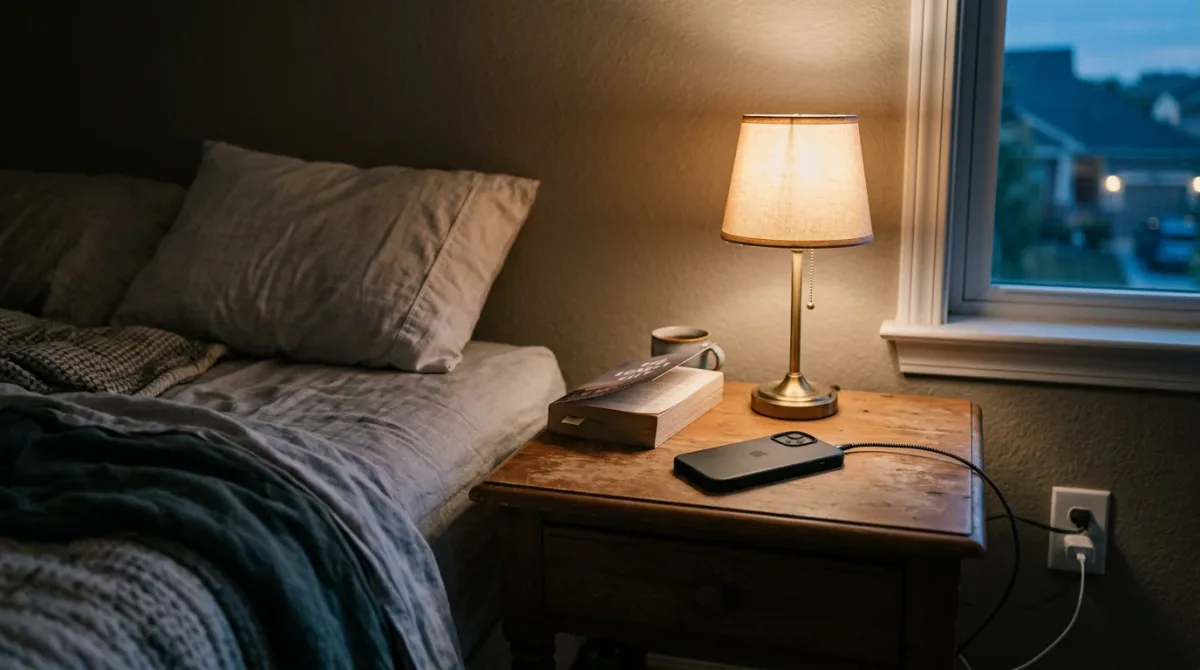
Studies consistently link more screen use before bed to later bedtimes and shorter sleep in children and teens, and pediatricians recommend turning devices off at least an hour beforehand. The research is mostly observational, though, so it shows a strong pattern rather than airtight proof of cause and effect.
Start with the pattern itself. a widely cited research review in the journal Pediatrics, led by sleep researcher Monique K. LeBourgeois with co-authors including Lauren Hale and Anne-Marie Chang, looked across dozens of existing studies of children and adolescents and found that in more than 90 percent of them, higher screen use was associated with delayed bedtimes and shorter total sleep time. About 75 percent of the children in the studies reviewed had at least one screen in their bedroom, and the authors note that a large share of children and teens already fall short of recommended sleep totals even before screens enter the picture.
Why would a screen affect sleep at all?
The Pediatrics review points to three separate mechanisms, and they don't all work the same way. A screen can simply eat into the clock ("time displacement" — a show or a game replaces minutes that would otherwise go to sleep). It can also be mentally activating, whether that's an exciting game, a group chat, or an argument on social media, which makes it harder to wind down regardless of what's on the screen. And light itself plays a role: the short-wavelength light common in phone and tablet screens suppresses the body's release of melatonin, the hormone that signals bedtime, and can push the internal clock later. The review notes children may be more sensitive to this light effect than adults, in part because of how their eyes let light through.
What the review is careful not to claim is that screens are the single cause of the sleep problem. Most of the underlying studies are observational and cross-sectional — they capture a snapshot of screen habits and sleep at one point in time — which means they can show a strong association without proving that the screen itself, rather than something else about how a household or a child spends the evening, is doing the causing. The authors also flag that most of the data relies on self-reported screen use, which is an imprecise way to measure something that changes as fast as kids' media habits do.
What do pediatricians recommend in practice?
The American Academy of Pediatrics, through its family-facing site HealthyChildren.org, translates that research pattern into two concrete steps: turn off all screens — televisions, computers, laptops, tablets, and phones — at least 60 minutes before bedtime, and keep screens out of children's bedrooms altogether, especially overnight. The AAP frames this as one piece of a broader "Family Media Use Plan" that parents build around their own household's routines, not a fixed rule that fits every family the same way.
The Centers for Disease Control and Prevention makes a similar recommendation as part of general sleep hygiene for all ages: turning off electronic devices at least 30 minutes before bedtime. The CDC's guidance sits inside its broader age-based sleep targets, which is useful context before deciding how strict a screen curfew needs to be in a given house.
How many hours of sleep does my child actually need?
The CDC publishes recommended sleep totals by age, counting naps where they apply. These are national public-health targets, not diagnoses for an individual child.
| Age group | Recommended sleep (24 hours) |
|---|---|
| Infants, 4-12 months | 12-16 hours, including naps |
| Toddlers, 1-2 years | 11-14 hours, including naps |
| Preschoolers, 3-5 years | 10-13 hours, including naps |
| School-age, 6-12 years | 9-12 hours |
| Teens, 13-17 years | 8-10 hours |
What does a screen-free wind-down actually look like?
Neither the AAP nor the CDC prescribes a single script, but their guidance points to the same basic sequence. This is a starting structure to adapt, not a mandate.
- Pick one cutoff time for all screens, counting back from your child's target bedtime — 60 minutes is the AAP's benchmark, 30 minutes is the CDC's floor.
- Move charging stations for phones and tablets outside the bedroom, including your own, so the household rule is visible rather than selectively enforced.
- Swap the cut screen time for something low-stimulation — reading, a bath, quiet conversation — so the change isn't just an absence.
- Hold the routine consistently for a week or two before judging whether it changed sleep, since one off night doesn't tell you much.
- Write the agreed cutoff and bedroom rule into a family media plan so it's a shared expectation, not a nightly negotiation.
What's the honest, unsettled part?
What the studies show is a consistent association between evening screen use and worse sleep, plus plausible mechanisms for why. What the AAP and CDC recommend is a screen curfew and screen-free bedrooms, as a precaution that costs little and fits the pattern in the data. What remains genuinely unresolved is how much of the effect is the light, how much is the mental stimulation, and how much is simply time that could have gone to sleep instead — the review itself says the field hasn't cleanly separated those threads. Whether a stricter cutoff, a looser one, or a content-based rule instead of a time-based one works better for your particular child and evening is a family call the research doesn't make for you.
This article is meant to inform that decision, not replace it: it isn't medical or parenting advice, and a pediatrician who knows your child is the right person to weigh in if sleep problems are persistent or severe.
For a related youth news perspective, read Ben Affleck and Matt Damon Make a Splash on Gossip Stone TV.
For more context, read Complete Guide to Building a Sustainable Wellness Routine.
For more context, read Screen time and sleep: what the research actually says.
For more context, read What the research says about shift work and sleep.