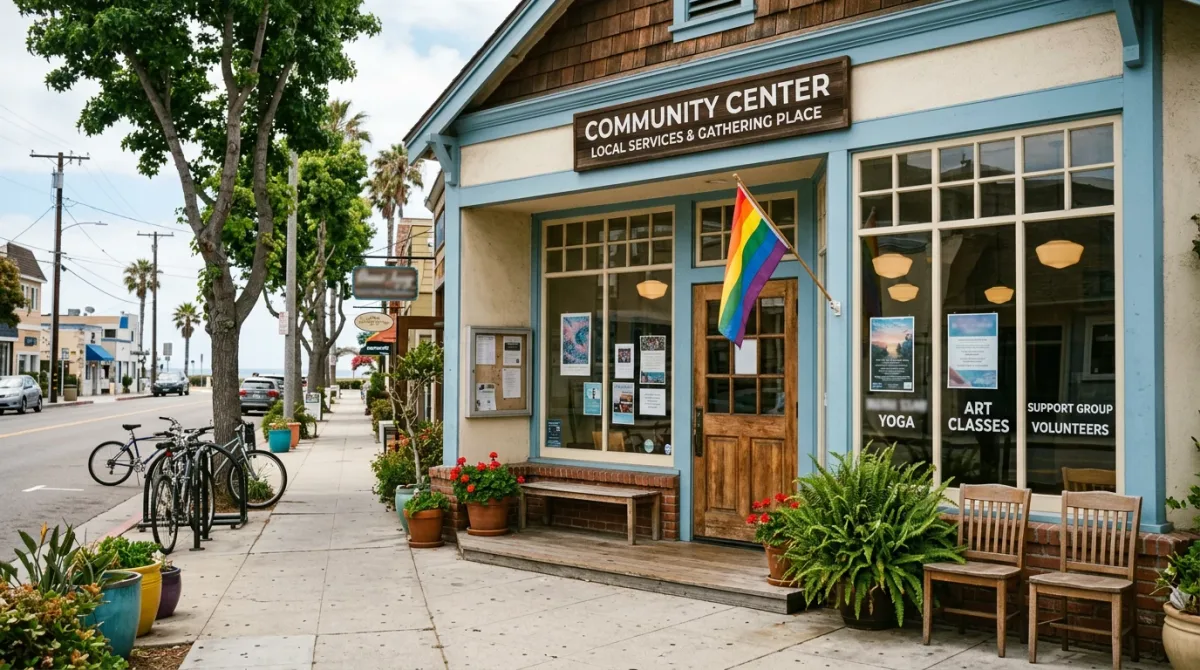
Pridelines, the Miami Beach nonprofit that traces its start to a 1982 peer support meeting, now runs six separate program tracks — from teen leadership groups to free HIV testing — out of its Washington Avenue building, making it Miami-Dade County's only year-round LGBTQ+ community center of its size and scope.
From a Circle of Chairs to a Full-Service Center
Pridelines describes its own arc simply: the organization has grown "from a circle of chairs in 1982 to an ecosystem of care for every generation across Miami-Dade County," according to its own history page. What began as an informal gathering is now a registered 501(c)(3) nonprofit headquartered at 1130 Washington Ave, First Floor, in Miami Beach, with a stated mission "to empower South Floridians of every generation through safe, affirming, and pluralistic spaces, whole-person wellness, and HIV prevention and care."
That mission statement matters because it signals a shift most people outside the organization don't track: Pridelines is no longer primarily a youth drop-in space, though youth programming remains one of its six pillars. It is a multigenerational health and social-services hub, and its own materials frame every age group, from teenagers to seniors, as a distinct constituency with distinct needs.
Six Circles of Care
Pridelines organizes its work into what it calls six interconnected service circles. Youth and Young Adults, serving ages 13 to 24, covers leadership development, scholarships, and sexual health education. Adult Programming includes Hermanos del Sol, bilingual services built for Latine men, and the Lavender Lounge, a cultural venue for adult community events. Senior Programming runs Los Guerreros, an HIV support track for older adults, alongside HALO's Coffee & Conversations for people 55 and up and the annual HALO Awards.
The remaining three circles are less visible from the outside but structurally central. A Mental Health Hub offers sliding-scale therapy with licensed clinicians. A Health & Wellness track covers HIV testing, STI screening, PrEP and PEP navigation, and primary care with mobile outreach. And a Faith & Spirituality program runs humanist and interreligious programming for members who want a spiritual community without leaving an affirming one.
Free HIV Testing, in Three Languages
The health side of that work is documented independently by the Centers for Disease Control and Prevention, which lists Pridelines in its National Prevention Information Network directory as a community-based organization offering free HIV self-tests and free HIV tests, condom distribution, HIV counseling, and prevention education, along with ongoing support groups. The CDC listing confirms the same Washington Avenue address and phone number Pridelines publishes itself, and notes services are offered in English, Spanish, and Haitian Creole.
The federal directory also spells out who the organization is built to reach: gay men and other men who have sex with men, LGBTQ+ people broadly, and Black, Hispanic, and low-income residents identified as at-risk populations. Appointments are required for testing, and the listing directs people to contact Pridelines directly about eligibility and current mobile testing locations, since those shift.
That level of specificity is worth sitting with. Federal directories generally don't list a community organization unless the organization has registered its services in detail — target populations, languages, and delivery method included. It's a small, bureaucratic confirmation of something Pridelines already says about itself: this isn't a general-interest social club that happens to also offer health referrals. Testing and prevention work is built into the organization's core structure, not bolted onto it.
One Piece of a Larger County System
Pridelines' testing program doesn't operate in isolation. Miami-Dade County runs its own HIV Prevention Unit through the Florida Department of Health, which offers free, confidential HIV and STI testing countywide through mobile units, plus at-home HIV test kits that deliver results in about 20 minutes and mobile screening for chlamydia, gonorrhea, and syphilis. Residents can reach the county's counseling and testing line at 786-792-5269 to schedule.
The county unit also coordinates with a roster of community and advocacy groups on outreach at health fairs and events. That countywide infrastructure is the backdrop Pridelines' own health programming sits against: a community organization built around one building and one staff can point people toward free testing and prevention resources, but it operates alongside — not instead of — the public health system that also serves Miami-Dade's broader population.
The distinction matters for anyone trying to figure out where to actually go. A person looking for a same-day, walk-up HIV test through the county's mobile units is working with a different intake process than someone requesting an appointment through Pridelines' own program, even though both draw on the same underlying public health goal. Neither replaces the other. Pridelines adds identity-specific programming — youth leadership, bilingual services for Latine men, senior support groups — around a health service the county also provides on a broader scale.
Reaching the Organization
Pridelines' center sits at 1130 Washington Ave, First Floor, in Miami Beach, and the organization can be reached at 305-571-9601. Both its own site and the CDC's federal directory list that same address and number, which is worth noting only because contact information for small nonprofits tends to drift as offices move — here, two independent sources agree. People asking about a specific program, from the Mental Health Hub's sliding-scale therapy to Los Guerreros' senior HIV support group, are directed to contact the organization directly, since intake and eligibility for services generally aren't handled through a public web form.
For a community center that started as a circle of chairs in 1982, that layered structure — youth programming, adult and senior circles, mental health care, a health and wellness track tied into county and federal prevention networks — is the clearest evidence of what four decades of continuous operation actually built. It is not a single service. It is a system, and it is still headquartered in the same city where it started.
For a related pride perspective, read Miami-Dade's LGBTQ+ Health Resources, From HIV Testing to Youth Support.
For more context, read Complete Guide to Building a Sustainable Wellness Routine.
For more context, read Where to Find LGBTQ+ Health Resources in Miami-Dade.
For more context, read Rockland's event calendars, explained.