
The Recommended Dietary Allowance for protein is 0.8 grams per kilogram of body weight a day — about 56 grams for a reference adult man and 46 grams for a reference adult woman, according to the National Academies' Dietary Reference Intakes report. That figure is a floor meant to prevent deficiency in a sedentary, healthy adult, not a universal target, and the same report allows a much wider range depending on your goals.
How Much Protein Does the RDA Actually Set?
The RDA is the amount of protein estimated to meet the needs of nearly all healthy people in a given life stage group, according to the National Academies' Dietary Reference Intakes report on energy and macronutrients. It's built from nitrogen-balance studies and expressed both as grams per kilogram of body weight and as flat daily totals for reference body sizes.
| Life Stage Group | RDA for Protein |
|---|---|
| Children, 4–8 years | 19 g/day |
| Males, 14–18 years | 52 g/day |
| Males, 19–50+ years | 56 g/day |
| Females, 14–18 years | 46 g/day |
| Females, 19–50+ years | 46 g/day |
| Pregnancy and lactation | 71 g/day |
These totals assume a reference body weight for each group. The National Academies report notes the underlying per-kilogram figure for adults is 0.8 grams of protein per kilogram of body weight per day, which is where the 56- and 46-gram totals come from.
Why Does the Acceptable Range Go So Much Higher Than the RDA?
Because the RDA is a minimum, not an upper limit. The same National Academies report sets an Acceptable Macronutrient Distribution Range, or AMDR, of 10 to 35 percent of daily calories from protein for adults. On a 2,000-calorie diet, the upper end of that range works out to roughly 175 grams a day — more than three times the RDA.
The AMDR exists because protein intake across that whole span is linked to a lower risk of chronic disease in the National Academies' review, not because everyone needs to eat toward the top of it. The RDA and the AMDR are answering different questions: one is “what's enough to avoid deficiency,” the other is “what range is generally considered safe and healthy.”
What Is the FDA's Protein Daily Value, and How Is It Different?
There's a third number in circulation, and it isn't the RDA either. The Food and Drug Administration's Daily Value for protein — the figure used to calculate the percentage on Nutrition Facts labels — is 50 grams for a 2,000-calorie diet, per Medical News Today's review of federal labeling standards. It's a single reference amount for label math, not a personalized target, and it sits between the sex-specific RDAs and the AMDR's upper bound.
Does It Matter Where Your Protein Comes From?
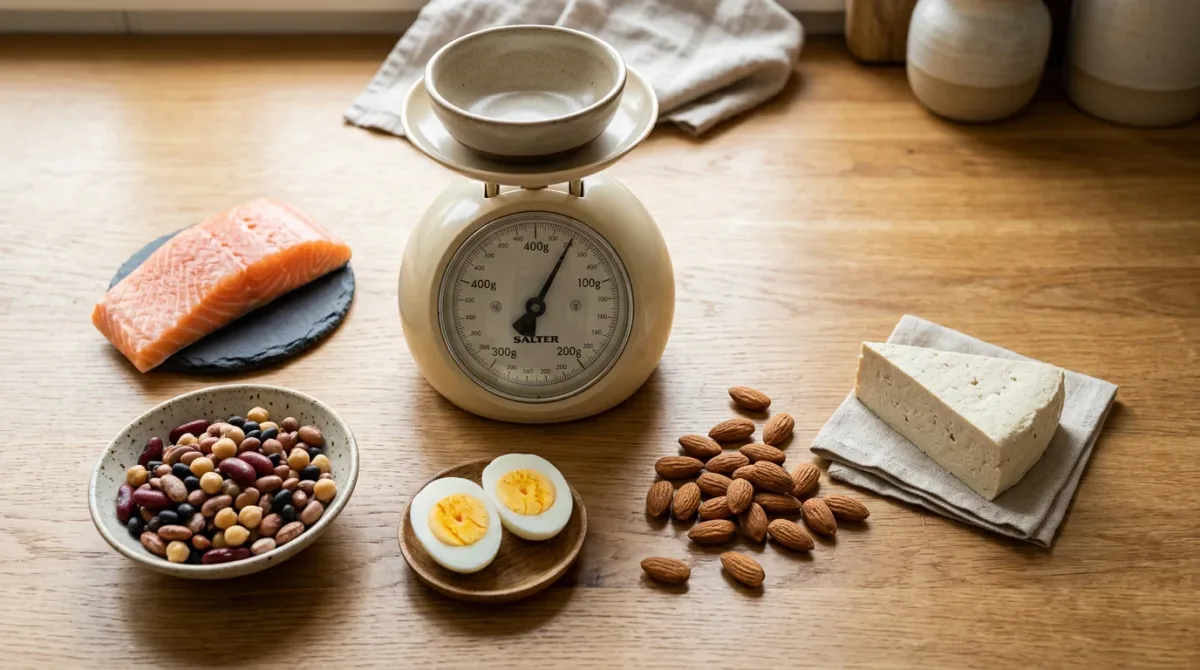
The protein food group itself is broad. The USDA's MyPlate protein foods guidance groups seafood, meat, poultry, and eggs with beans, peas, lentils, nuts, seeds, and soy products, and recommends adults 19 and older aim for roughly 5 to 7 ounce-equivalents a day depending on age and sex.
Within that group, source can matter for amino acid completeness. Complete proteins contain all nine essential amino acids the body cannot make on its own; animal foods, soy, and quinoa fall into that category, according to Medical News Today's explainer on protein sources. Most other plant foods are considered incomplete on their own but can combine over the course of a day — rice with beans, or peanut butter on whole-wheat bread — to supply the same full amino acid profile.
Can Eating Too Much Protein Cause Problems?
The evidence here is thinner than the RDA and AMDR figures above. Medical News Today's reporting states that consistently exceeding protein needs “will not provide any additional health benefits and may contribute to serious health problems, such as kidney issues,” without citing a specific study or naming an affected population. That claim should be read as a general caution rather than a settled finding — the National Academies' own AMDR review treats intakes across the 10-to-35-percent range as broadly acceptable for healthy adults, and the two sources aren't fully reconciled in what's available here. Anyone with existing kidney disease is a different case, addressed below.
When to Talk to a Clinician
This article covers general population guidance, not personal medical advice. Talk to a doctor or registered dietitian before changing your protein intake if you have kidney disease, are on dialysis, take medications that affect protein or mineral metabolism, are pregnant, or are an older adult with a shrinking appetite or unintentional weight loss. A clinician can weigh your specific labs and health history in a way a general RDA table can't.
The Bottom Line
The RDA of 0.8 grams per kilogram of body weight is a floor for healthy adults, not a ceiling — the National Academies' own AMDR allows 10 to 35 percent of calories from protein, and the FDA's label Daily Value of 50 grams is a separate reference point again. For anything beyond general eating patterns, especially with a kidney condition or other diagnosis, the next sensible step is a conversation with a clinician or registered dietitian who can look at your specific numbers.
For a related fitness perspective, read How Many Steps a Day Do You Actually Need? What the Research Says.
For more context, read Complete Guide to Building a Sustainable Wellness Routine.
For more context, read How Much Protein Do Active Adults Actually Need?.
For more context, read protein requirements for women.