
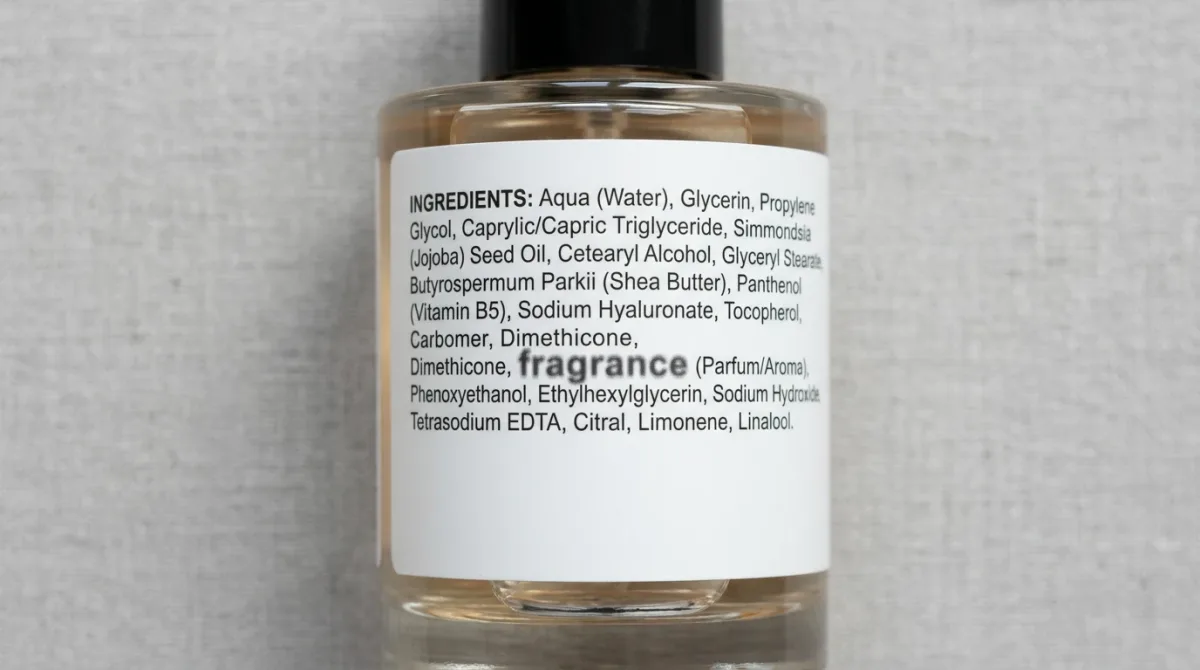
Federal law still lets a cosmetic label say simply "fragrance" or "parfum" and stop there, covering a proprietary blend that can run to dozens of unnamed ingredients. A 2022 law, the Modernization of Cosmetics Regulation Act (MoCRA), directs the Food and Drug Administration to write a rule requiring fragrance allergens to be disclosed on labels — but as of FDA's own MoCRA regulatory overview, that rule exists only as a requirement FDA has not yet finalized, with no published allergen list, format, or compliance date.
Why can a label just say "fragrance"?
The single word covering a multi-ingredient scent mix is not an oversight; it is a specific legal accommodation. Under the Fair Packaging and Labeling Act and FDA's trade-secret regulation at Title 21 CFR 20.61(a), a company can request confidential treatment for a "commercially valuable plan, formula, process, or device" — and fragrance and flavor formulas have long been treated as the ingredients most likely to qualify, since a competitor could reverse-engineer a full ingredient list into a copycat scent. To get that protection, a company has to document to FDA how the formula is kept confidential internally and what it would be worth to a competitor to know it. FDA describes the review as case-by-case, and notes that a company must choose trade-secret status or patent protection — it cannot claim both for the same formula.
That legal architecture is why "fragrance" or "parfum" can appear as one line on an ingredient panel even though, chemically, it may represent 50 or more individual compounds. FDA notes that trade-secret status is granted only "on rare occasions" after individualized review, that the agency commits to an interim response within 180 days of a request, and that a company must pick trade-secret status or patent protection for a given formula — not both. Fragrance and flavor houses have relied on that framework for generations, treating the finished scent, rather than its component molecules, as the protected trade secret.
It is also, per FDA's own MoCRA overview, exactly the gap the 2022 law was written to narrow — not by ending trade-secret protection, but by carving allergens specifically out of it.
What does MoCRA actually require, and when does it take effect?
MoCRA is the broadest expansion of FDA's cosmetic authority in decades: it added mandatory facility registration, annual product listing, adverse-event reporting within 15 business days, and a general safety-substantiation requirement for the industry. Fragrance allergen labeling is one piece of that law, and FDA's own current guidance describes it as a regulation the agency "requires FDA to establish" — language that describes an obligation still being worked out, not a rule already in force. The agency's public rulemaking tracker lists the measure, formally "Disclosure of Fragrance Allergens in Cosmetic Labeling," as being in the proposed-rule stage under the FDA's Office of the Chief Scientist, with the statutory deadline for a proposal having already passed the agency's original target. No allergen list, labeling threshold, or effective date has been finalized or published.
For readers waiting for a U.S. label to name specific fragrance allergens the way MoCRA eventually requires, that day has not arrived. Nothing on a current cosmetic label sold in this country is required to name individual fragrance allergens, and no brand is out of compliance for continuing to list "fragrance" as a single term while the rule is written.
The federal unified rulemaking tracker lists the measure, formally "Disclosure of Fragrance Allergens in Cosmetic Labeling," under FDA's Office of the Chief Scientist with an "other significant" priority designation, alongside the agency's separate MoCRA work on facility registration and adverse-event reporting that is already binding on manufacturers.
Which ingredients in "fragrance" actually cause reactions?
Allergic contact dermatitis — an itchy, sometimes blistering rash that develops where a substance touches skin — can be triggered by many things, and cosmetics and fragrances are among the categories the Mayo Clinic names as common culprits. Mayo Clinic singles out Balsam of Peru, a resin-derived fragrance and flavor ingredient long used in perfumes, as an example of a substance that shows up in many products and can provoke this kind of reaction in sensitized skin. The mechanism is an immune response to a specific chemical, not to "fragrance" as a category — which is precisely why regulators and dermatologists have pushed for individual allergens to be named rather than folded into one catch-all word.
This is general information, not a diagnosis: a rash that recurs after using a scented product is a reason to see a dermatologist or allergist, who can patch-test for the specific trigger, rather than to self-diagnose from an ingredient list.
What actually changes for shoppers right now — and what doesn't
Nothing changes on shelves today. The practical relevance of MoCRA's fragrance provision, for now, is that it signals where federal labeling is headed, not what it currently requires. For New Yorkers layering multiple scented products through a day of subway commutes and office HVAC, the honest state of the label has not moved: "fragrance" still means undisclosed, and a product marketed as "fragrance-free" is a brand's own claim rather than a federally defined term — worth noting the next time a product description leans on either phrase. FDA's product listing and adverse-event provisions under MoCRA are already in effect for manufacturers, which means the agency now has more visibility into what companies report internally, even before the allergen-disclosure rule itself is finalized.
Until FDA publishes a proposed rule with an actual allergen list, the most reliable way to identify a personal trigger remains what it has always been: a dermatologist's patch test, not a label read. Until then, the word "fragrance" on a label stays a legal category rather than a chemical one — shorthand for a formula no regulation yet requires a brand to unpack.
For a related business news perspective, read MoCRA's First Renewal Deadline Has Passed: What It Means for Beauty Brands.
For more context, read How State Cellphone Ban Laws Actually Work in K-12 Schools.
For more context, read Small packages lose their tariff exemption.
For more context, read How to become a certified nursing assistant in New York.