
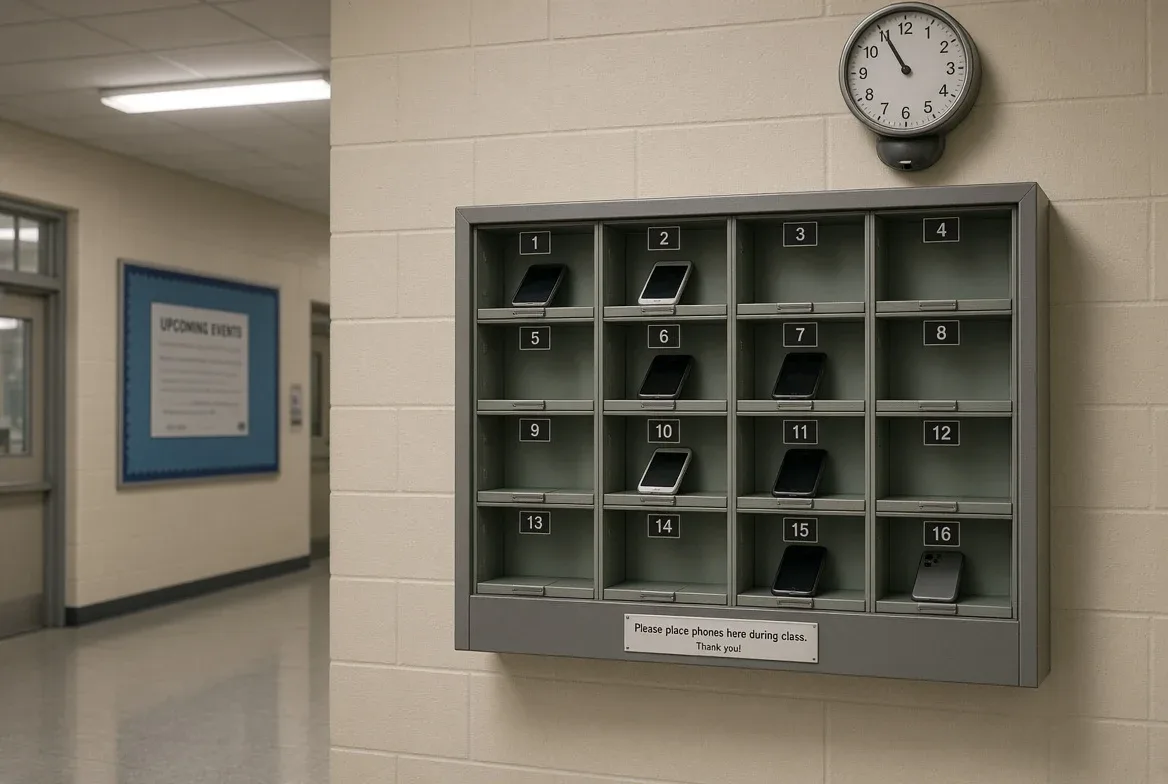
A state cellphone ban law is legislation requiring public school districts to adopt a policy that limits or prohibits student smartphone use during the school day. As of January 2026, at least 26 states have enacted full-day "bell-to-bell" versions, according to a state-by-state count compiled by Newsweek, though storage rules, discipline, and exemptions differ by state.
For administrators and teachers, the practical questions are rarely about whether phones should be restricted — public opinion has largely settled that question — but about what the statute actually obligates a district to do, by when, and with what exceptions. Those details determine how much local discretion a school board retains and how much enforcement burden lands on classroom teachers.
What Does a State Cellphone Ban Law Actually Require?
Most state cellphone laws do not ban phones directly; they require local school boards or charter authorizers to adopt a written policy restricting use, then set minimum standards that policy must meet. California's Phone-Free School Act, known as Assembly Bill 3216, follows this structure: it requires every school district, charter school, and county office of education to "develop a policy to limit or prohibit the use of smartphones by pupils while they are at a public school" and to update that policy at least once every five years.
Governor Gavin Newsom signed AB 3216 on September 23, 2024, and districts have until July 1, 2026 to have a policy in place, according to the bill-signing statement published by the Governor's Office. That same statement cites two figures often used to justify the mandate: 72% of high school teachers and 33% of middle school teachers report phone distraction as a major classroom problem, and separate survey data cited in the release found that 97% of students use phones during the school day, for a median of 43 minutes.
How Strict Are the Rules — Bell-to-Bell or Classroom-Only?
States differ sharply on how much of the school day a restriction covers. An analysis of all 50 states and the District of Columbia, reported by Education Week, grades state laws on a five-point scale based on scope and storage requirements, and found wide variation rather than a single national standard.
| Grade | What the law requires | Approximate number of states |
|---|---|---|
| A | Bell-to-bell ban with phones stored somewhere inaccessible during the day | 2 |
| B | Full-day ban but storage can be a locker or backpack the student can reach | 17 states plus D.C. |
| C | Restriction applies only during instructional time; use allowed between classes or at lunch | 8 |
| D | State requires districts to have some policy but does not specify what it must contain | 9 |
| F / none | No ban legislation passed, or none introduced | 6 |
The distinction between an A-grade and a B-grade state matters operationally: when storage is merely a backpack or locker rather than a locked pouch, enforcement of the "inaccessible" requirement falls largely on individual teachers, according to the Education Week analysis. States such as Arizona, California, and Ohio fall closer to the classroom-only end of that scale, restricting phones during instruction rather than the full school day, per Newsweek's state tracker.
What Exemptions Do These Laws Typically Include?
Every version of these laws that has been reported on carves out exceptions for safety and disability accommodations. California's AB 3216 requires that any district policy allow phone use "in the case of an emergency, or in response to a perceived threat of danger, or as allowed by a teacher, administrator, doctor or the student's individualized education program," according to the bill-signing announcement from the Governor's Office. That IEP carve-out matters for students with disabilities whose accommodation plans specify device use for communication, health monitoring, or accessibility needs.
Newsweek's reporting on the broader 26-state landscape similarly notes that most jurisdictions build in allowances for medical or emergency needs, even where the underlying ban is otherwise strict. States rarely spell out a single national exemption list; individual district policies typically translate the state's minimum exceptions into local procedures, such as how a student requests permission or where a medical-use phone is kept during the day.
How Are Districts Handling Phone Storage?
The storage mechanism is where state mandates translate into a district's day-to-day operations, and it is also where the Education Week analysis identifies the sharpest practical divide. Locked pouches — a magnetically sealed pouch a student carries but cannot open until a staff member releases it — are treated in the analysis as the most consistent way to make a ban's terms enforceable across a building, without singling out individual students for repeated confiscation.
Districts using lockers, classroom caddies, or a simple backpack rule report a lighter equipment cost but push more of the day-to-day enforcement onto individual teachers, since a phone can be reached between the classroom door and a locker down the hall. Neither approach is uniformly mandated by state law; in most B- and C-grade states, the choice of storage method is left to the local school board within the state's broader restriction.
What Does the Evidence Say About Effects So Far?
Direct outcome data are still limited, and any claim about test scores or attendance should be read as coming from specific, named studies rather than as a settled national finding. The Education Week analysis cites a district-level study in Florida that found second-year improvements in test scores and attendance after a phone restriction took effect, and it references a national survey effort called "Phones in Focus," led by researcher Angela Duckworth, that links locked-pouch storage to improved classroom attention. Both findings are reported secondhand in that analysis rather than drawn from the original studies directly, and neither has been independently verified here.
The same analysis also reports improved teacher satisfaction in districts that adopted bans, based on educator surveys it cites. None of this evidence supports a guarantee that a ban will change outcomes for any individual school; effects reported in specific districts do not automatically generalize, and a school's results will depend on its own enforcement, exemptions, and student population.
Where Do State Cellphone Laws Go From Here?
Momentum has been toward stricter rather than looser rules. Twenty-two states enacted new K-12 cellphone legislation in 2025 alone, layering onto laws passed in earlier years, and by January 2026 only two states — Montana and South Dakota — had no cellphone-restriction bill introduced at all, according to the Education Week analysis. For districts still finalizing a policy, the near-term compliance question is less about whether to restrict phones and more about which storage mechanism, discipline ladder, and exemption process will hold up to a state's minimum requirements — and to a parent's first phone call about a missed message during the school day.
Coverage of state education policy continues to track how these mandates play out district by district as compliance deadlines arrive through 2026.
For a related education perspective, read Operation HOPE Lands in Alabama to Help Boost Financial Literacy and Empower Communities Across the State.
For more context, read How to become a certified nursing assistant in New York.
For more context, read What it takes to become a registered nurse in New York.
For more context, read Small packages lose their tariff exemption.