
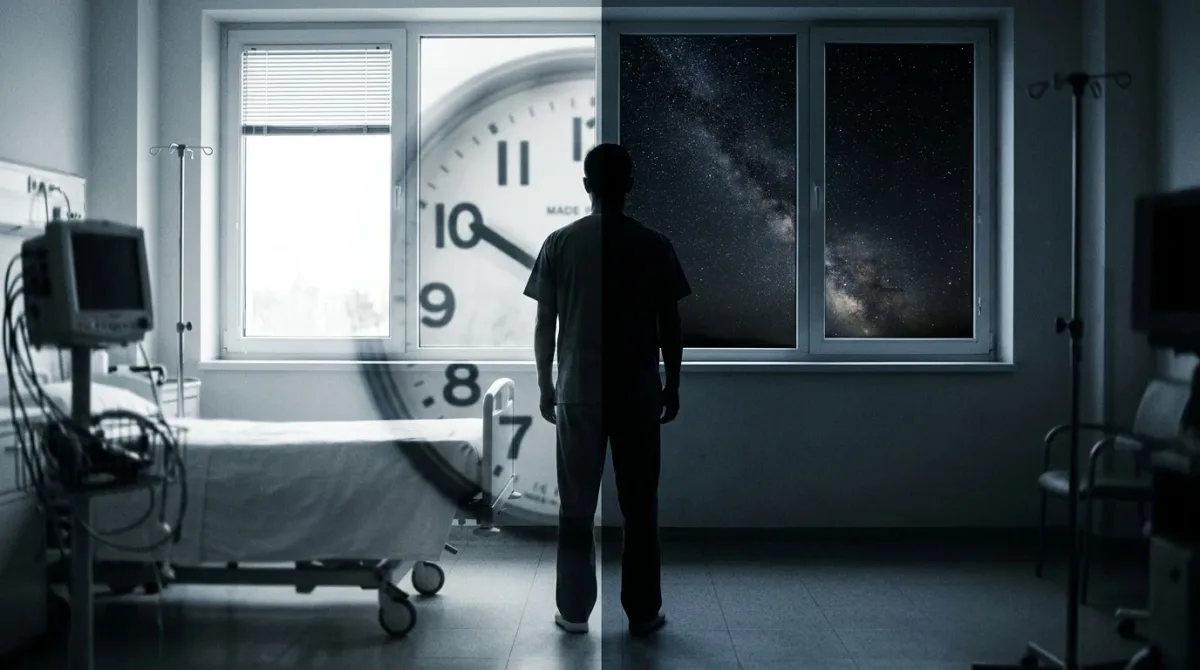
Night shift work does not simply shorten sleep. It splits the body's timekeeping system in two. In a laboratory simulation published in the Proceedings of the National Academy of Sciences in 2018, 24 of the 65 rhythmic blood metabolites tracked in participants shifted by roughly 12 hours within days of a night schedule, while the brain's master clock barely moved.
That gap — a master clock still running on day time, organ clocks racing toward night time — is the mechanism underneath most of what federal occupational health agencies describe when they list the hazards of shift work. This article is information, not medical or career advice; decisions about sleep, medication, or a work schedule belong with a reader's own clinician.
How does the body keep time?
Two systems govern alertness, according to the NIOSH training module for nurses on shift work and long work hours. The homeostatic sleep drive accumulates pressure across waking hours and discharges it during rest. Circadian rhythms run a roughly 24-hour cycle that sets when alertness peaks and when it falls away.
Light synchronizes the second system, and blue wavelengths do most of that work, the module states. When a schedule runs against the cycle, NIOSH describes the outcome as desynchronization: the body is asked to perform during the hours it has been tuned to shut down, and to sleep during the hours it has been tuned to wake.
The module frames the consequences as a chain rather than a single effect. Disturbed sleep and disturbed circadian rhythms produce, in its wording, “stress, fatigue, negative mood, discomfort, physiologic dysfunction, and poor health behaviors (overeating, smoking, and lack of exercise).” Long hours compound that by extending exposure to workplace hazards and cutting recovery time.
What happens to that system on a night shift?
The clearest published picture of the split comes from a 2018 experiment at Washington State University, summarized by the National Institutes of Health. Researchers led by Hans P. A. Van Dongen and Shobhan Gaddameedhi put volunteers through simulated day and night shift schedules and measured 132 metabolites in their blood.
Sixty-five of those metabolites showed significant daily rhythms. On the night-shift schedule, only three — taurine, serotonin, and sarcosine — kept peaking in step with the brain's master clock. Twenty-four others moved by about 12 hours. Van Dongen said the biological clocks in digestive organs are “so profoundly and quickly changed by shift work schedules, even though the brain's master clock barely adapts.”
The limits matter. The study, published in the Proceedings of the National Academy of Sciences in 2018, involved 14 participants — 10 men and four women, aged 22 to 34 — in a controlled laboratory simulation, not a working hospital. Findings from a sample that size describe a mechanism. They do not measure how any individual worker will respond to a rotation.
How many workers are on non-daytime schedules?
Sixteen percent of workers usually worked a non-daytime schedule in 2017-18, according to the Bureau of Labor Statistics survey of job flexibilities and work schedules released on Sept. 24, 2019. Evening shifts accounted for 6% and night shifts for 4%, with the remainder spread across rotating, split, and other arrangements.
That release, drawn from a leave and job flexibilities module of the American Time Use Survey, does not break out figures for healthcare occupations or for individual states, and it remains the reference point most often cited for national shift prevalence. Readers looking for New York-specific shift counts will not find them in that table.
Which health outcomes has NIOSH linked to shift work?
The NIOSH nurse training module lists the conditions that research has associated with disturbed sleep and circadian disruption. It presents them as risks elevated across populations of shift workers, not as outcomes attached to any one schedule or person.
- Cardiovascular disease
- Gastrointestinal disorders
- Cancer
- Diabetes mellitus
- Musculoskeletal disorders
- Psychological complaints
- Impaired reproductive outcomes
NIOSH also treats fatigue as an occupational safety problem rather than a private one. The module notes that mistakes by fatigued nurses can carry “broad-reaching negative effects on the community,” including medical errors and motor vehicle crashes on the commute home, and that employers absorb the cost through lost productivity and liability.
What has federal review concluded about cancer risk?
The National Toxicology Program published a cancer hazard assessment of night shift work and light at night on April 27, 2021. It reported high confidence that persistent night shift work disrupting circadian rhythms can cause breast cancer in women, and concluded that such work may also cause prostate cancer in men.
For lighting itself, the program reported moderate confidence in a causal relationship between human cancer and lighting conditions that cause circadian disruption — defined in the assessment as excessive light at night combined with insufficient daylight exposure. A hazard assessment identifies a capacity to cause harm; it does not quantify an individual worker's risk, and the program's conclusions are framed at the level of persistent exposure over time.
What do sleep specialists point to as countermeasures?
Meghna Mansukhani, a sleep medicine physician at Mayo Clinic in Rochester, Minnesota, described the underlying conflict plainly in a Mayo Clinic question-and-answer piece published on Dec. 20, 2016: when a shift worker has to work, the internal rhythm wants them to sleep.
The measures she outlined work on the light signal and on sleep opportunity. Bright light during the working shift and dark sunglasses on a sunrise commute both push the circadian system toward the schedule the job demands. A consistent sleep schedule, a dark, cool and quiet bedroom, regular exercise, and limited alcohol address the second half of the problem.
On duration, Mansukhani's guidance was that adults need seven to eight hours of sleep per 24 hours, and that running on five hours or fewer is a problem rather than an adaptation. That figure is her clinical statement as reported by Mayo Clinic, not a target this publication sets.
When to talk to a clinician
Mansukhani's threshold in the Mayo Clinic piece was practical: a worker who applies those measures consistently for two weeks and still cannot get enough sleep should talk to a doctor. Persistent sleepiness on shift, insomnia during the off-shift sleep window, or symptoms that interfere with driving are matters for a clinician rather than for self-management.
Nothing here diagnoses shift work sleep disorder or any other condition, and nothing here should be read as a recommendation about medication, supplements, or whether to accept or leave a night rotation. Those are decisions for a reader and their own clinician, with the specifics of their schedule and health history in front of them.
For a related prevention perspective, read A bad night's sleep can cut immune cell activity by nearly a third, federal fatigue research shows.