New York City's Percent for Art law requires that one percent of the budget for eligible city-funded construction projects be set aside for artwork, according to the Department of Cultural Affairs, which administers the program. Enacted in 1982 under Mayor Edward I. Koch, the law has funded more than 300 permanent installations in civic buildings across the five boroughs.
The program touches a category of buildings most New Yorkers pass without a second look: firehouses, courthouses, police precincts, public schools, hospitals, shelters and sanitation garages. Because the artwork is commissioned rather than acquired ready-made, the process runs on a script that has changed only once since the Koch administration, and it involves more people than a single curator's eye.
How does the one percent rule work?
The mechanism is arithmetic before it is aesthetic. Once a capital project is designated eligible, the Department of Cultural Affairs calculates one percent of its construction budget and that sum becomes the commission fee for a specific artist, covering design, fabrication and installation. The formula applies uniformly, so a modest firehouse renovation and a large hospital expansion each generate an art budget proportional to their own cost rather than a citywide pool distributed by committee.
Which projects are covered?
Eligibility is limited to city-owned capital construction projects that provide public services. According to the Department of Design and Construction, which acts as project manager on implementation, that list includes schools, firehouses, police precincts, courthouses, hospitals, clinics, correctional facilities, parks structures, shelters and sanitation facilities. Privately funded developments, even those built on city land, generally fall outside the law's reach; the projects that qualify are the ones New Yorkers already fund through the capital budget.
Who decides which artist gets the commission?
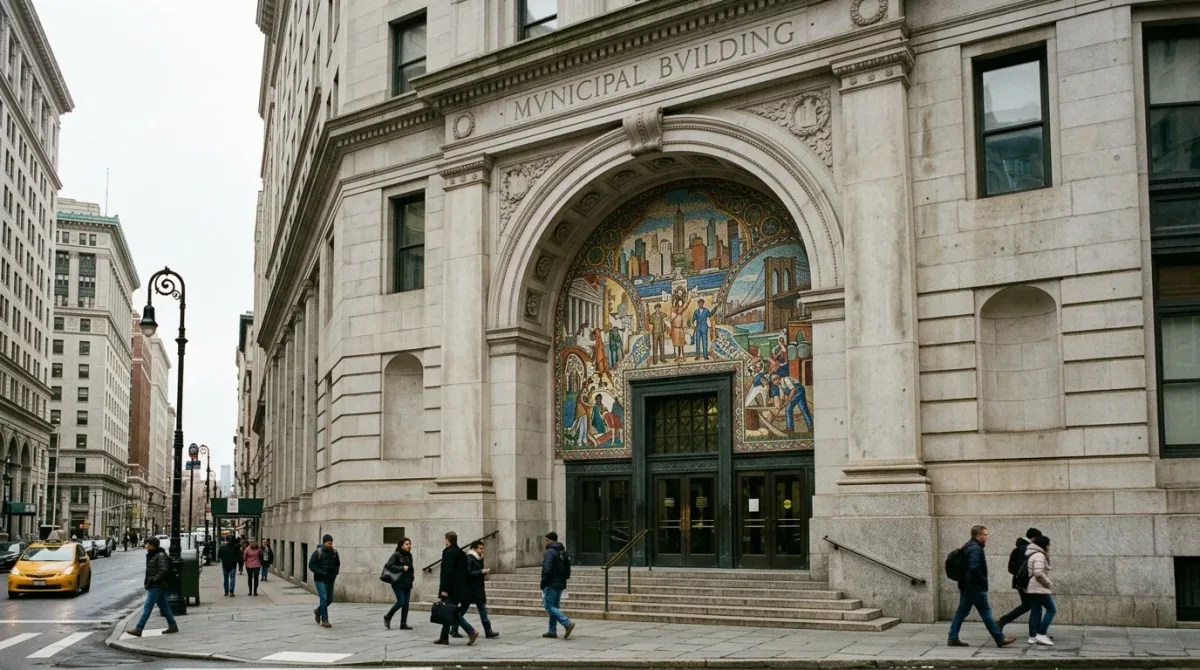
Selection is deliberately distributed rather than left to one office. The Department of Cultural Affairs oversees an artist selection process intended to reflect the diversity of the city's population, working alongside the city agency that owns the building, the project architect, an artist selection panel and local community members. The Department of Design and Construction then serves as liaison for turning the chosen proposal into a built, permanent work integrated with the site — a mosaic in a stairwell, a sculpture at an entrance plaza, glasswork set into a facade.
Because the work is site-specific, finalists are typically asked to respond to the particular building and neighborhood rather than offer an existing piece from a studio. That distinguishes the program from acquisition-based public art initiatives elsewhere, where a completed sculpture is simply purchased and placed.
How did the program begin, and has the law changed?
The idea predates its 1982 enactment by nearly two decades. A version of the concept was first sketched under Mayor Robert Wagner in 1965, then stalled through New York's fiscal crisis of the mid-1970s before the City Council finally passed the measure under Koch. The first completed commission, Jorge Luis Rodriguez's sculpture "Growth," was installed in 1985 and later became the program's own logo.
The law itself went largely untouched for more than three decades. In 2015, the City Council passed its first amendment since 1982, adding earlier public meetings during a project's design phase and stronger requirements for advertising public hearings, a change that gave community members a say before an artist's concept was finalized rather than after. Coverage of the program's thirty-year run, published by Hyperallergic, traced that amendment to City Councilmember Jimmy Van Bramer and then-DCLA commissioner Tom Finkelpearl.
What happens when a commission draws objections?
Site-specific public art occasionally collides with the neighborhoods it is meant to serve, and the program's history includes a small number of disputes. In 1991, bronze sculptures by John Ahearn installed outside a South Bronx police station were removed after community members objected to what they read as racially charged imagery. More recently, a proposed sculpture by Ohad Meromi, budgeted at roughly $500,000 under the one percent formula, drew public criticism over its cost relative to neighborhood priorities. Such episodes are the exception rather than the rule across three hundred-plus completed projects, but they illustrate why the 2015 amendment moved public input earlier in the design process rather than after a design was already set.
For a program built on a fixed formula rather than discretionary grants, the result is a form of public art that is easy to overlook and hard to dislodge: it exists because a building was built, its cost was fixed before an artist was chosen, and it belongs, permanently, to the civic structure it was made for.
For a related art perspective, read How a public artwork gets commissioned in New York.
For more context, read How to become a certified nursing assistant in New York.
For more context, read What it takes to become a registered nurse in New York.