
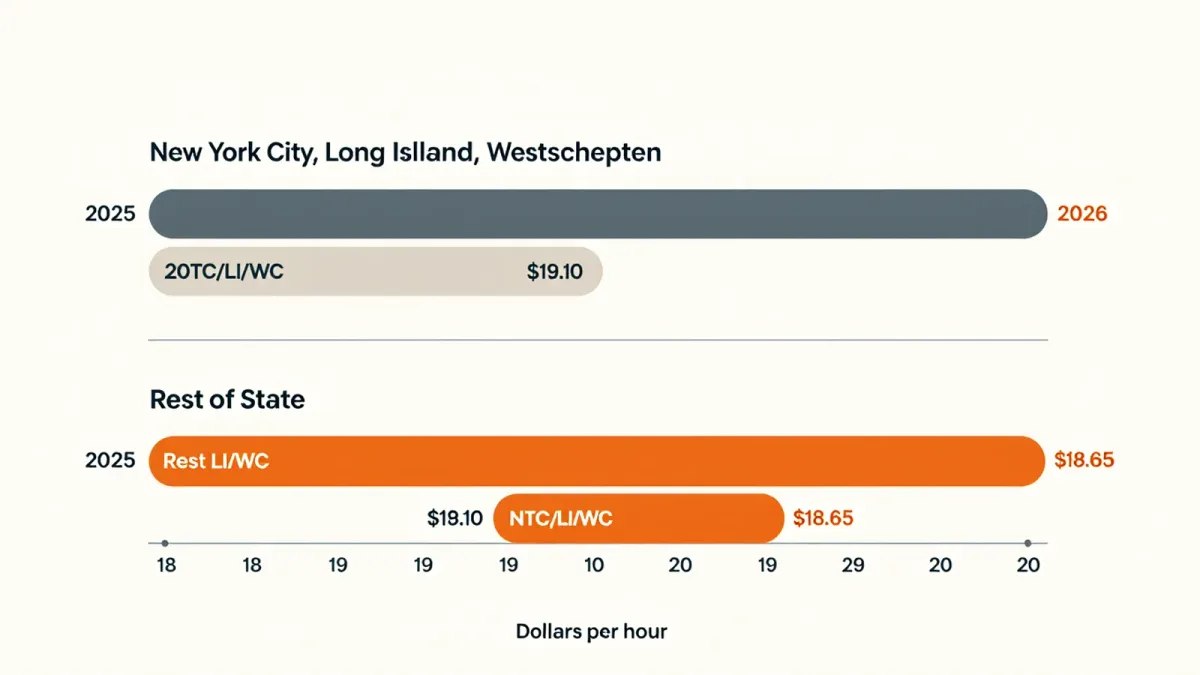
New York's home care aide minimum wage rose on January 1, 2026 to $19.65 an hour in New York City, Long Island, and Westchester, and $18.65 an hour in the rest of the state, per the state Department of Labor's wage schedule. The increase adds roughly $1,100 a year for a full-time aide in the downstate region compared with the 2025 floor.
HEALTH WORK NY publishes information, not career or medical advice. The figures below come from the Department of Labor's published schedule and from analyses of the statute behind it.
How the wage floor works
Home care aides are paid under a separate, higher minimum wage than most New York workers. Under the Fair Pay for Home Care Act, enacted in the 2022-23 state budget, aides must be paid at least $2 above the applicable general minimum wage. The general minimum wage also rose on January 1, 2026 — to $17.00 an hour in New York City, Long Island, and Westchester and $15.20 upstate — which is what moves the aide floor to $19.65 and $18.65, per the Department of Labor's Home Care Aide Minimum Wage fact sheet.
Not every household employer is covered the same way: aides employed through licensed home care services agencies, consumer-directed programs, and certain family arrangements fall under different rules, and the department's fact sheet is the controlling source for a specific worker's case. Collective bargaining agreements can also set different scales.
What it changes for workers
The 55-cent step raises the annual earnings of a 40-hour-per-week aide in the downstate region by about $1,144 before taxes, against the 2025 floor of $19.10. For aides scheduled below full time — common in home care, where guaranteed hours are scarce — the annual gain scales down proportionately. Overtime rates, which are calculated from the regular rate, rise with the base.
The raise also functions as a recruiting signal in a labor market where home care vacancies have persistently outpaced hires. Industry groups and unions disagree about whether the wage floor is sufficient — 1199SEIU and other supporters of Fair Pay for Home Care argue the profession still loses workers to retail and other sectors paying comparable wages with fewer physical demands — but the January 1 increase is the statutorily scheduled movement, not a new policy decision.
The timing also matters for agency budgeting. Most licensed home care services agencies bill Medicaid or managed long-term care plans for aide hours, so wage floors flow through reimbursement negotiations rather than private pay rates. Aides employed directly by households, including those hired through consumer-directed programs, are paid from state-funded budgets that adjust with the schedule, which is why the January 1 change lands across the sector at once rather than employer by employer.
What aides should check on their first 2026 paycheck
The new floor applies to hours worked on or after January 1, 2026. Workers paid exactly at the old floor should see the regional rate rise to $19.65 or $18.65, depending on where the work is performed. Spread-of-hours and overtime rules still apply on top of the base. Workers who believe their rate did not adjust can file a claim with the Department of Labor, which enforces the wage order; the agency's published fact sheet lists the current rates and coverage rules.